UCLA Anderson professor Bhagwan Chowdhry writes that until online transactions are free of onerous regulations and fees, and are more intuitive to learn to use, cash will remain king for many.
History professor Brenda Stevenson writes that 150 years after emancipation in the United States, there are still 20 to 30 million people enslaved around the world.
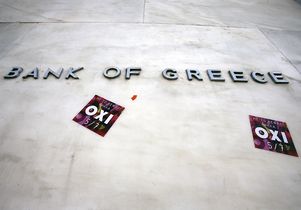
UCLA Anderson finance professor Bhagwan Chowdhry writes that allowing developing nations to raise money similarly to how startups raise equity funding could help stave off future crises like happened in Greece.
Fernando Torres-Gil writes that Americans can learn a lot from how two of the country’s fastest growing populations are learning how to embrace change.
UCLA Anderson professor Daniel Oppenheimer co-wrote an op-ed that says while the upcoming vote won’t save the economy, a vote at least may prevent social and political upheaval.
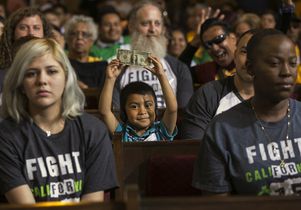
Gary Blasi of the UCLA School of Law co-wrote a Los Angeles Times op-ed imploring L.A. city officials to prioritize providing housing to the homeless over seizing their possessions.
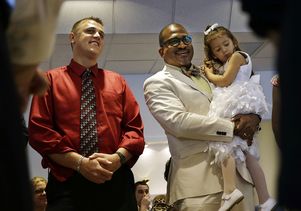
Law professor Douglas NeJaime writes in the Los Angeles Times that the struggle for full legal protections and equal rights has not ended for gay and lesbian families.
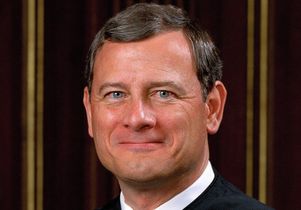
Adam Winkler notes that the legal reasoning used by Chief Justice John Roberts in the decision that upheld the president’s signature health care law will preserve it against future challenges.
Law professor Eugene Volokh writes in the L.A. Times that he thinks the University of California needs to remember the special place universities hold as forums for opposing ideas and open debate.
Better mentorship, revised performance reviews and more transparency are among the recommendations shared at a recent UCLA conference that attempted to figure out how to increase the number of women in tech.
Glen MacDonald writes that rising temperatures, groundwater depletion and a shrinking Colorado River mean the most populous U.S. state will face decades of water shortages and must adapt.
Jon Christensen writes that artist Michael Heizer’s monumental sculpture called “City” best embodies the Western ethos of humanity’s role shaping and adapting to the vast open expanse.
Professor Phillip Leslie writes that we shouldn’t let fear of private companies intruding on our privacy prevent us from reaping the benefits of using large data sets to enact policies.
Law professor Adam Winkler writes that there are two cases — one famous and one forgotten — that may haunt the chief justice and explain his recent pivot away from the court’s conservative bloc.
UCLA law professor Steven Bank explains possible reasons why FIFA’s leader shocked the world and said goodbye to the organization he ruled with an iron wallet for more than a decade.
The director of the Center for Gender-Based Biology at UCLA co-wrote an op-ed stating that we should be careful not to confuse the properly banned gay-conversion therapy with potentially helpful therapy for gender dysphoria.
The research director at UCLA’s Center X writes about how teacher evaluations that include hours of observation and student feedback, among other criteria, foster trust between educators and those grading them.
M.V. Lee Badgett of the Williams Institute writes that in the May 22 election, voters in historically Catholic Ireland, might legalize nationwide same-sex marriage before Americans.
Education professor Mike Rose writes in the Washington Post that character education is no substitute for improving poor students’ lives by addressing inequality.
Psychiatrist Peter Whybrow explores the epidemic of debt in modern America and how consumerist culture has warped Americans’ brains into reckless spending.
Daniel J.B. Mitchell says that to help avoid a repetition of contentious funding battles around the UC budget, the 55-year-old state Master Plan for Higher Education needs updating.
Behavioral economist Shlomo Benartzi’s research shows that smarter and simpler website and app design can guide people to save for retirement properly.