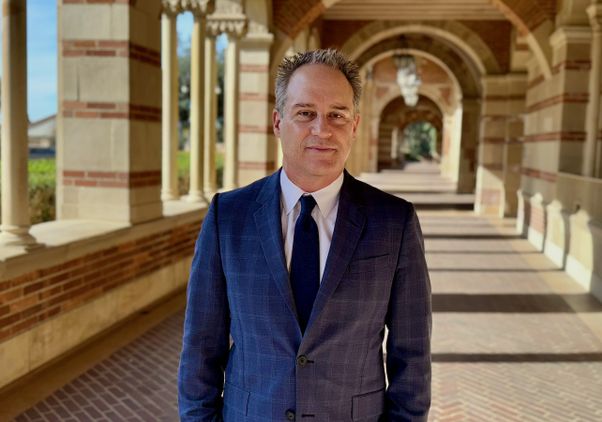
Jesse Rissman, assistant professor of psychology, is one of 25 young scientists at research universities across the country chosen to receive grants totaling more than $12 million for basic research to address some of the Department of Defense’s most challenging technological hurdles.
From a field of 226 applicants, the tenure-track faculty members were selected to receive up to $1 million each over the course of three years for their research.
Rissman's research explores the interplay of attention and memory, using functional magnetic resonance imaging (fMRI) to characterize the neural circuits that support these fundamental cognitive processes. His winning project is titled "Giving Classic Learning Principles a Virtual Makeover: Neural Correlates of Effective Retrieval of Memories Formed in a Virtual World."
Projects in Rissman's laboratory seek to elucidate how moment-to-moment changes in a person's behavioral goals can serve to sculpt neural activity within sensory cortices and the medial temporal lobe memory system, exerting a profound influence over what information gets encoded into, maintained in, or retrieved from memory. His work also examines how the act of bringing past experiences back to mind, via the neural reactivation of specific event details, can facilitate the generation of memory-based predictions that guide future behavior.
To learn more, see this.