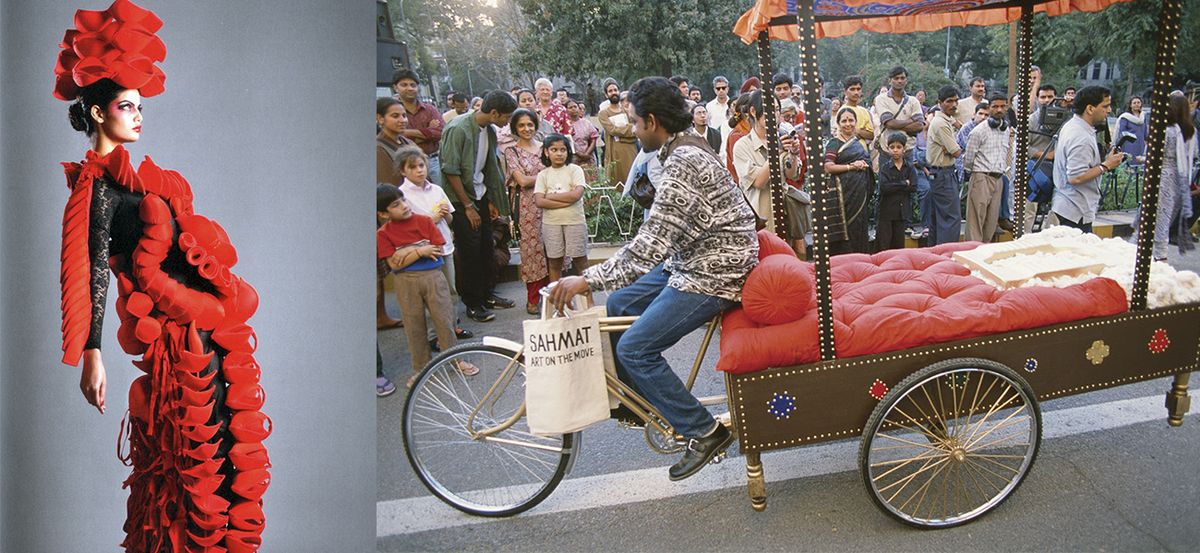
The Fowler Museum at UCLA will present two exhibitions featuring works by contemporary artists from India: “Making Strange: Gagawaka + Postmortem by Vivan Sundaram” and “The Sahmat Collective: Art and Activism in India since 1989.” Both open April 19.
“Making Strange: Gagawaka + Postmortem by Vivan Sundaram”
“Making Strange” presents groundbreaking recent projects by Delhi-based Vivan Sundaram, a founding member of the Sahmat Collective and one of the leading artists working in India today. The exhibition brings together two striking bodies of work, “Gagawaka” (2010–11) and “Postmortem” (2013), for the first time in North America. The exhibition’s title refers to the Brechtian strategy of “estrangement” or “defamiliarization,” and points to Sundaram’s self-conscious engagement with aesthetic traditions of the European avant-garde.
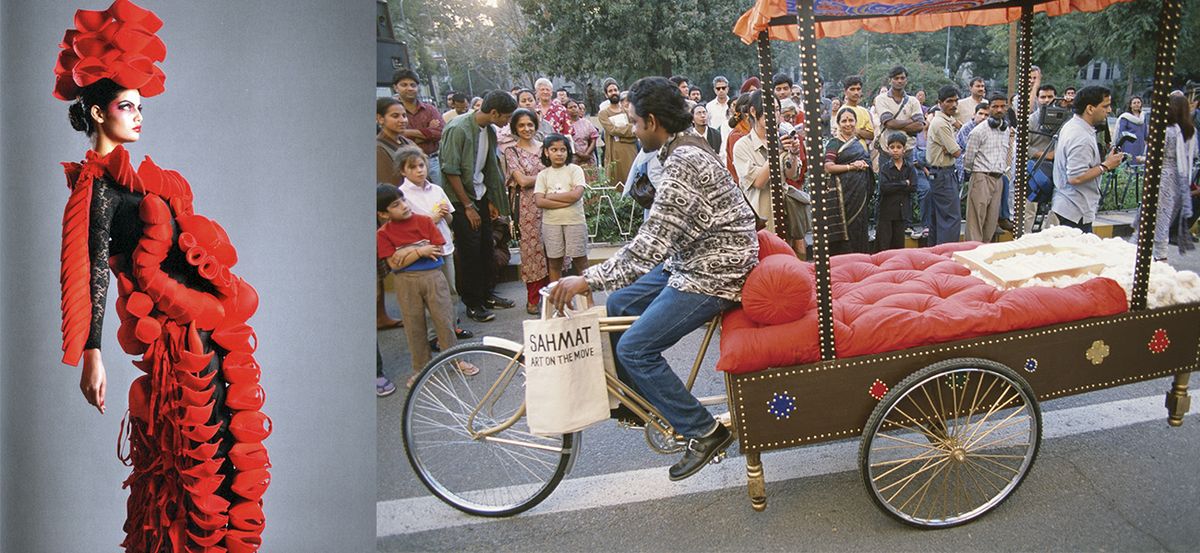
“Gagawaka” comprises 27 sculptural garments made from recycled materials and medical supplies to evoke a playful yet subversive relationship to fashion, haute couture, the runway and the brand. “Gagawaka,” an invented word with pop-culture references to Lady Gaga and the 2010 World Cup anthem, “Waka Waka,” represents the artist’s own fictional brand and line of “strange” haute couture. Gagawaka’s highly inventive garments — made of foam cups, surgical masks, x-ray film, hospital bandages and foil pill wrappings — challenge the excesses of fashion and question the increasingly extravagant consumerism that has emerged in India.
“Gagawaka” is presented in dialogue with “Postmortem,” a collection of haunting sculptural objects fashioned out of mannequins, tailor’s dummies, wooden props and anatomical models, and deploys surrealist (or post-surrealist) devices to present the human body on a more disquieting stage. Postmortem questions the spectacle of “Gagawaka” with a wider set of commentaries about the human body and social concerns related to aging and illness, and it highlights the very different bodily experiences associated with high fashion and health care.
“When one thinks of the dialogue between fashion and health, countless conditions of global crises come to mind; for instance, the entanglement between the sweatshop and the brand, the testing of pharmaceuticals in developing nations, and the environmental impact of biomedical waste,” said Saloni Mathur, the exhibit’s co-curator and a UCLA associate professor of art history. “Sundaram’s work invites us into a world that may well be in fragments, but that is resilient and finds its means to repair by returning to elemental functions and discarded forms.”
“Making Strange” is presented in the Fowler’s 5,700 square-foot Getty Gallery within a highly theatrical setting sympathetic to the fashion spectacle of “Gagawaka.” The interpenetrating spaces of the installation foreground the provocative relationship between the couture garments of “Gagawaka” and the peculiar anatomical sculptures and models of “Postmortem.” For Sundaram, the juxtaposition of these projects should not be viewed “as if one follows the other, or that Postmortem is destroying or dismantling everything that was in Gagawaka.” To the contrary, Sundaram said, it reveals a “constant shifting of different meanings that informs a lot of my work and I hope this becomes apparent in the spirit of holding these shows together.”
Born in 1943 in Shimla, India and based in New Delhi, Sundaram was trained as a painter at M.S. University of Baroda and at the Slade School of Fine Art in London in the 1960s; he returned to India in 1970 and began a series of solo and group exhibitions. From 1990, he began to move toward sculpture, installation, photography and video. His work has been widely exhibited in India and in several international biennials, and in solo shows in India, North America and Europe.
The exhibition’s other co-curator is Miwon Kwon, professor and chair of the art history department at UCLA.
“Making Strange” is organized by the Fowler Museum at UCLA. Major funding is provided by the Barbara and Joseph Goldenberg Fund, the Ahmanson Foundation, on the recommendation of Foundation trustee emeritus Lloyd E. Cotsen, the National Endowment for the Arts, the Pasadena Art Alliance, the Shirley and Ralph Shapiro Director’s Discretionary Fund, and Manus, the support group of the Fowler Museum. Additional support comes from Catherine Benkaim and Barbara Timmer. Public programs and educational outreach activities are made possible in part by the Ralph M. Parsons Foundation.
Visit the exhibition website for the full news release.
“The Sahmat Collective: Art and Activism in India since 1989”
In 1989, playwright, actor and activist Safdar Hashmi was fatally attacked by political enemies while performing a street play outside Delhi. His death led supporters to found Sahmat, an artist’s collective that has enabled Indian artists to create and present works that engage in important political and social debates, and the subject of a new exhibition at the Fowler Museum at UCLA.
Through a mix of art and ephemera, “The Sahmat Collective: Art and Activism in India since 1989,” organized by the Smart Museum of Art at the University of Chicago, uniquely situates two decades of contemporary Indian art within the political sphere while offering a meditation on art’s capacity as a force for change.
“For the American viewer it may help to see these works in the context of the ‘culture wars’ as they are playing out in India,” said Ram Rahman, a photographer and the exhibit’s co-curator. “Sahmat’s projects also reflect the camaraderie and community spirit of the Indian art scene, where artists of different generations and philosophical outlooks still have a close-knit sense of community and purpose.”
Sahmat is both an acronym for the Safdar Hashmi Memorial Trust and the Hindi word for “in agreement.” The Delhi-based group’s mission is to maintain “the essentially pluralist and democratic spirit of creative expression in India.” To this end, Sahmat has engaged a broad base of collaborators — from celebrated artists and scholars to writers, musicians and rickshaw drivers — to create and present art that defends freedom of expression and battles intolerance within India’s often-divisive political landscape.
The exhibition will introduce Sahmat to the U.S. by examining key projects from 1989 to the present, including street-based shows, large cultural sit-ins, performances and conceptual exhibitions. In addition to surveying Sahmat’s multifaceted history, the exhibition will assess the impact this unique — and sometimes controversial — collective has had on contemporary Indian society and artistic practice.
Sahmat projects are defined in part by their consistent stance against the threat of religious fundamentalism and sectarianism — known in South Asia as “communalism” — in public life. Collaborations have cut across class, caste and religious lines and have involved artists, performers, scholars and a wide array of other participants, such as the Hindu, Sikh and Muslim auto-rickshaw drivers in the contest “Slogans for Communal Harmony.” Projects also have sought to counter political distortions to India’s history, most notably in Sahmat’s multifaceted response to the demolition of Babri Masjid (Babur’s Mosque) in Ayodhya. In other cases, Sahmat has sought to celebrate India’s cultural diversity and democratic ideals, engaging artists to create work that responds to ideas of national history and individual identity.
“The Sahmat Collective” is also curated by Jessica Moss, associate curator for contemporary art at the Smart Museum.
The exhibition is made possible by the Smart Family Foundation; Helen Zell; the Efroymson Family Fund, a CICF Fund; the Joyce Foundation; and the National Endowment for the Arts.
Visit the exhibition website for additional images and the full news release.
Public Programs
Saturday, April 18
6 p.m.
Opening Program: Vivan Sundaram and the Sahmat Collective
Saloni Mathur and Miwon Kwon, co-curators UCLA faculty members in art history, will host Vivan Sundaram for a conversation about his art practice and his involvement with India’s most influential collective in contemporary art. Co-presented as part of the Arts of Bandung Humanism Conference.
7–9 p.m.
Opening Reception
Join us for a preview of “The Sahmat Collective” and “Making Strange,” light refreshments and music. Members’ Lounge cocktail hour from 5–6 pm. RSVP to fowlerRSVP@arts.ucla.edu.
Sunday, May 17
12:30 p.m.–4 p.m.
Arts of India Festival
This afternoon festival celebrates Indian arts and culture through a variety of activities and performances that highlight social awareness, collaboration and creativity for all ages. Visit the festival website for more information.
July
Kids Muse Summer Camp: Make It, Build It, Wear It
Session 1 (ages 6 to 8): July 20–24, 9 a.m.–4 p.m.
Session 2 (ages 9 to 12): July 27–31, 9 a.m.–4 p.m.
Cost: $230 for Fowler members, $275 for non-members
Create art robots, crazy costumes and forts in this action-packed, art-filled camp inspired by “The Sahmat Collective” and “Making Strange.” Includes field trips and scavenger hunts all over the UCLA campus.
The Fowler Museum at UCLA is one of the country’s most respected institutions devoted to exploring the arts and cultures of Africa, Asia and the Pacific, and the Americas. The Fowler is open Wednesdays through Sundays, from noon to 5 p.m.; and on Thursdays, from noon until 8 p.m. The museum is closed Mondays and Tuesdays. The Fowler Museum, part of UCLA Arts, is located in the north part of the UCLA campus. Admission is free. Parking is available for a maximum of $12 in Lot 4. For more information, the public may call 310-825-4361 or visit fowler.ucla.edu.