Scientists had assumed the core was rotating at about the same speed as the surface, but this surprising observation might reveal what the sun was like when it formed.
An international team of astronomers has observed a striking spiral pattern in the gas surrounding a red giant star called LL Pegasi and its companion star 3,400 light-years from Earth.
A “baby” solar system 300 light-years away has given astrophysicists from UCLA and the Carnegie Institution for Science a rare peek at the formation of a planet.
A UCLA-led team of scientists discovered a white dwarf star in the constellation Boötes whose atmosphere is rich in carbon, nitrogen, oxygen and hydrogen.
UCLA’s Jonathan Aurnou and collaborators in Marseille, France, demonstrated that the planet’s jets likely extend thousands of miles below its visible atmosphere.
The Joseph Weber Award for Astronomical Instrumentation is given for outstanding design, invention or significant improvement of instrumentation leading to advances in astronomy.
A UCLA-led research team reports that the moon is at least 4.51 billion years old and probably formed only about 60 million years after the birth of the solar system — 40 million to 140 million years earlier than had been thought.
UCLA professor Henry Kelly examines historical canonical legal procedures to correct the popular myths around the Italian astronomer’s belief in a sun-centered solar system.
Kepler-62f could have atmospheric compositions that allow it to be warm enough to have surface liquid water, which would make it possible for the planet to support life.
The researchers made the discovery using an effect called gravitational lensing to see the incredibly faint object, which was born just after the Big Bang.
Jura played a major role in advancing scholarship in his field and in shaping UCLA’s Division of Astronomy and Astrophysics over the course of four decades.
The violent impact with a “planetary embryo” called Theia occurred approximately 100 million years after the Earth formed, UCLA geochemists and colleagues report.
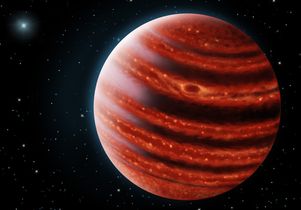
A planet 100 light-years away that resembles a young Jupiter has been discovered by an international team of astronomers that includes six UCLA scientists.
The astrophysicist is being honored by the UK academy for her 'acclaimed discoveries ... on the motions and nature of the stars orbiting the black hole in the centre of our Galaxy.'