While University of California campuses have never asked about an applicant's criminal history as part of the application process, the practice is used by other universities.
Law professor Noah Zatz argues that the sentencing concept of “working off debt” violates the 13th Amendment's prohibition against involuntary servitude and disproportionately punishes communities of color.
Research on incarceration in the United States by UCLA Luskin public policy professor Michael Stoll figures prominently in a newly released report on criminal justice reform by the White House Council of Economic Advisors.
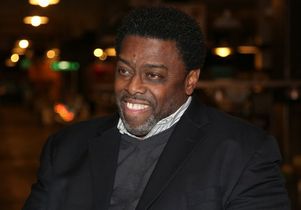
Bryonn Bain, a new professor of African-American Studies at UCLA, draws on his experiences with racial profiling along with his Harvard law degree to shape his art and to advocate for justice reform.
Thanks to the law school’s Supreme Court Clinic, the court will issue rulings on cases dealing with free speech, the right to a speedy trial, search and seizure, and deportation.
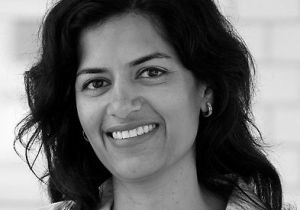
Ana Muniz, director of the Dream Resource Center at the UCLA Labor Center, recently published "Power, Police, and the Production of Racial Boundaries," a book on policing in Los Angeles.
With an impressive string of cited amicus briefs and appellate litigation appearances, UCLA Law faculty members are making an impact on important issues.
The model, developed from six years of mathematical research and a decade of police crime data, has been so successful that the LAPD adopted it for use in 14 of its 21 divisions.
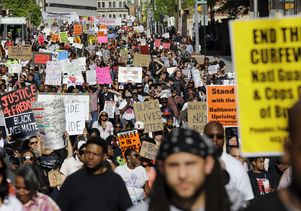
Dismissing unrest in America’s cities as aimless violence overlooks the roots of people’s anger, according to the panelists at a UCLA-Zócalo event examining the history of urban resistance.
UCLA professor Michael Stoll chronicles shift from getting tough on crime with policies like mandatory minimum sentences to smarter approaches to crime and punishment.
History professor Robin D.G. Kelley writes that claiming rioters are sabotaging “legitimate” efforts to bring about racial and social justice mistakenly presupposes that “legitimate” efforts have been working.
The UCLA Law School in conjunction with the Healthy Campus Initiative and many student groups will present "From Healing to Action: Advancing Policing Equality" on Feb. 23 at 6 p.m. in the UCLA School of Law, room 1347.
Carissa Phelps, who received her M.B.A. from the UCLA Anderson School and J.D. from UCLA School of Law, was once a victim of human trafficking and is now an author and advocate for those forced into the sex trades.
Luskin Dean Franklin Gilliam says citing statistics about racial disparities can be persuasive for reform advocates, contrasting a recent Stanford study that said the statistics were an ineffective persuasive tool.
A study co-authored by a UCLA public policy professor found some positive effects in Rhode Island after the state accidentally made prostitution legal for seven years.
A small group of law students from UCLA has helped community advocates add their voice to the debate over who should oversee the investigation of inmate abuse and monitor what's going on in L.A. county jails.
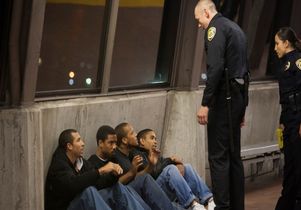
First-time violent juvenile offenders sentenced to probation camps are more than twice as likely to be involved in future criminal behavior than youths sentenced to in-home probation.
UCLA social psychologist Phillip Atiba Goff says that big data can help to make the world a better place — not be known only as an invasion of privacy.
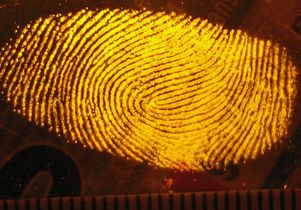
Using objective visual characteristics could help increase the accuracy of fingerprint identification and help labs assess which print comparisons might require special care.