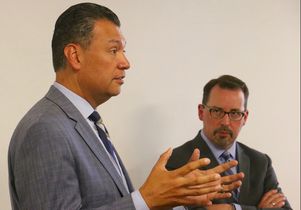
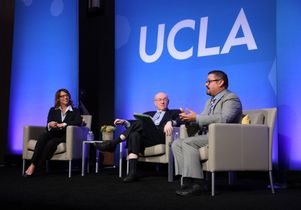
UCLA Luskin School of Public Affairs students get a valuable lesson in voting and elections from California Secretary of State Alex Padilla and Los Angeles County Registrar Dean Logan.
The wave of protests that erupted after Donald J. Trump’s unexpected presidential victory was no surprise to Zachary Steinert-Threlkeld, an assistant professor in the UCLA Luskin School of Public Affairs Department of Public Policy.
Misunderstanding voters’ feelings, the natural unreliability of polling and insufficient skepticism from journalists contributed to predictions showing Hillary Clinton would be president.
Lynn Vavreck notes that ads using someone’s own words against them register as more memorable and truthful to voters, a strategy Clinton has used several times.
As part of the UCLA history department’s “Why History Matters” series, the panelists discussed demagogues, the media and gender dynamics in the contest between Clinton and Trump.
A UCLA political scientist and an American University political historian talked about the key factors in the presidential election Tuesday night before a packed crowd at the Hammer Museum.
David Shulman outlines why he will reluctantly vote for a Democrat in November, how Donald Trump betrays American values and what Republicans need to do to regain their party.
UCLA’s Lynn Vavreck writes in The New York Times that people’s opinions about abortion tend to converge when they’re asked to evaluate specific situations rather than simply express support or opposition.
That most people have never heard of Hatshepsut — a pharaoh of ancient Egypt, who was the greatest female ruler of the ancient world — is emblematic of the challenges women have always faced in politics, writes UCLA Egyptologist Kara Cooney.
UCLA professor Lynn Vavreck writes in The New York Times that if the Democrats lose the Senate, it would follow recent electoral history for the party of an unpopular president. Also, watch a video of Vavreck speaking about political TV ads.