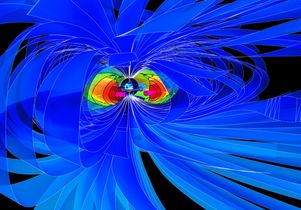
New findings by a UCLA-led team of researchers answer a question about our space environment and will help scientists protect telecommunication and navigation satellites.
Kepler-62f could have atmospheric compositions that allow it to be warm enough to have surface liquid water, which would make it possible for the planet to support life.
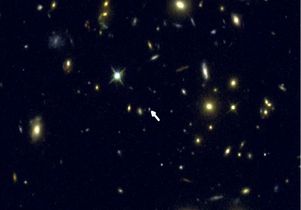
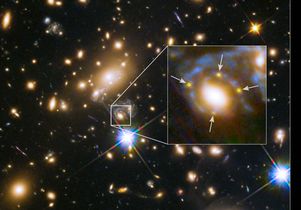
The researchers made the discovery using an effect called gravitational lensing to see the incredibly faint object, which was born just after the Big Bang.
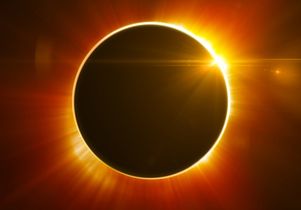
The August 2017 expedition to Swan Valley Idaho is presented by UCLA Alumni Travel, which was launched 75 years ago for sojourners who share a passion for learning.
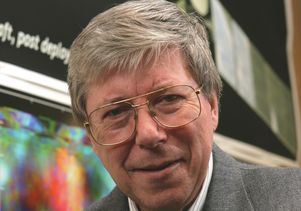
The award is given annually 'for the greatest achievement in aeronautics or astronautics in America, with respect to improving the performance, efficiency, and safety of air or space vehicles.'
The violent impact with a “planetary embryo” called Theia occurred approximately 100 million years after the Earth formed, UCLA geochemists and colleagues report.
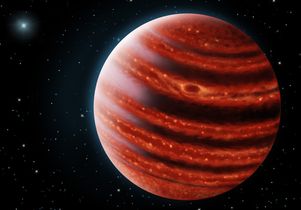
A planet 100 light-years away that resembles a young Jupiter has been discovered by an international team of astronomers that includes six UCLA scientists.
Glen MacDonald, UCLA’s John Muir Memorial Endowed Chair in Geography, and Laurence C. Smith, professor and chair of the UCLA Department of Geography, have been elected to the Class of 2015 Fellows of the American Geophysical Union.
NASA’s Dawn mission is observing the dwarf planet Ceres from 2,700 miles above its surface; the space agency has released new images and a video animation.
Raphael Rose, associate director of UCLA’s Anxiety and Depression Research Center, has been awarded a grant from NASA for research to support the health of astronauts on deep space missions.
UCLA and the Jet Propulsion Laboratory will sign a Memorandum of Understanding on May 27 to enable collaboration in the planetary sciences between the two institutions that will promote the stature, visibility and excellence of the field.
The moon does not influence the timing of human births or hospital admissions, a new UCLA study finds, confirming what scientists have known for decades.
Astronaut and three-time UCLA alumna Anna Lee Fisher addressed a roomful of students Monday at a UCLA Careers in Chemistry and Biochemistry to talk about her career and the lessons she learned while she attended UCLA.
Most of the laws of nature treat particles and antiparticles equally, but stars and planets are made of particles, or matter, and not antiparticles, or antimatter. That asymmetry puzzled scientists for many years.