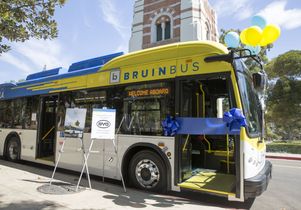
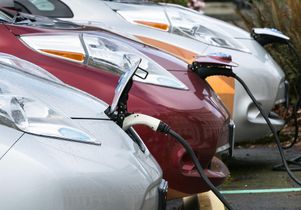
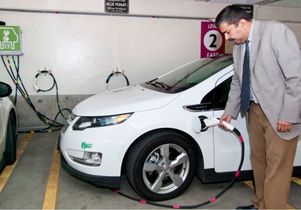
UCLA becomes the first public university in California with electric buses, which join the 14 compressed natural gas buses that get people around campus.
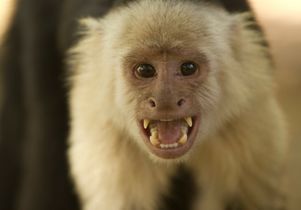
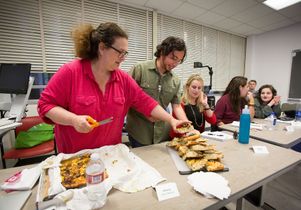
UCLA lecturer Andy Rice introduces his students to entomophagy, bug eating, which may someday become a smart alternative to resource-intensive foods such as beef.
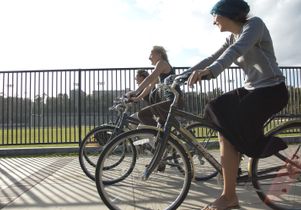
The League of American Bicyclists ranks UCLA as a Silver Bicycle-Friendly University. A holder of that distinction since 2011, UCLA is one of just 10 schools to move up in standing over the last year.
Popular KCRW “Good Food” host Evan Kleiman is treating UCLA students to a thoughtful exploration into issues of food and sustainability in her summer course, “We are Stardust: The Moral Ecology of Food."
The L.A. Energy Atlas project, a first-of-its-kind interactive website, enables policymakers and the public to sort energy consumption and emissions by building size, neighborhood and other metrics.
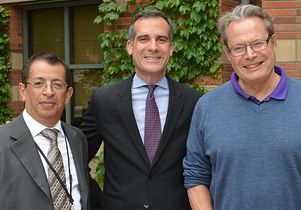
Mary Nichols, chair of the California Air Resources Board and a UCLA faculty member, is a fierce fighter for the environment. She has championed a difficult cause without succumbing to bitterness or wallowing in the polarization that has crippled Sacramento and Washington.
Jankowska is recognized for her service to and support of sustainability at UCLA and for furthering the role of academic libraries in sustainability initiatives nationwide.
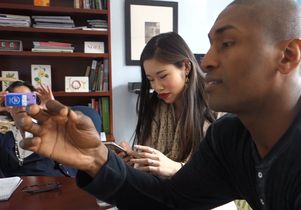
J.R. DeShazo, director of the Luskin Center for Innovation and member of the Institute of the Environment and Sustainability, talks about the state of car transportation in Los Angeles, California and beyond.
U.S. Deputy Secretary of Energy Elizabeth Sherwood-Randall met Tuesday with stakeholders from across the energy ecosystem at UCLA’s Kerckhoff Hall to discuss how Los Angeles can meet its energy goals.
If you’ve ever contemplated becoming a vegetarian, check out how eating a plant-based diet isn’t just good for your health. It happens to also be good for the Earth’s health.
For more than 40 years, issues surrounding genetically modified organisms—GMOs—have been full of controversy, curiosity and confusion. On Tuesday, April 19, four experts will debate the environmental, social and health impacts of GMO foods.
Experts debate the environmental, social and health impacts of genetically modified organisms (GMO) foods in this Oppenheim Lecture from the UCLA Institute of the Environment and Sustainability.
Lee Cooper writes about how UCLA’s Sustainable LA Grand Challenge will leverage the university’s students to make Los Angeles energy and water independent.
The initiative will train a new generation to help achieve a set of ambitious U.N.-approved goals to reduce poverty and hunger, improve health, advance education and make cities more sustainable.
As part of the United Nations World Water Day on March 22, UCLA will take part in Tuesday’s White House Water Summit that aims to raise awareness of water challenges in the United States.
Tata Power Delhi Distribution Limited and researchers at UCLA have reached an agreement to develop advanced technologies for delivering energy more efficiently, less expensively and to more people in India and beyond.
The UCLA Sustainable LA Grand Challenge’s first competitive research grants will go to 11 projects, ranging from developing lightweight solar panels that double as batteries to studying the costs of algae-based biofuels.
Robinson shared the story of her awakening to the global impact of climate change on the world's impoverished countries and communities at a lecture hosted by the UCLA Luskin School of Public Affairs Tuesday.