With as many accolades and laurels that have been showered on legendary film producer-director Stanley Kramer during his lifetime, would one more tribute — this one to celebrate his 100th birthday posthumously — make much of a difference?
Apparently, this one does. “Champion: The Stanley Kramer Centennial,” an upcoming retrospective on his work hosted by the UCLA Film and Television Archive and the Hugh M. Hefner Classic American Film Program, has become a flame to which a cloud of Hollywood names are being drawn like winged moths to honor a champion for social justice whose gripping films unflinchingly took on such hot-button subjects as racism, greed, fascism and nuclear armageddon.

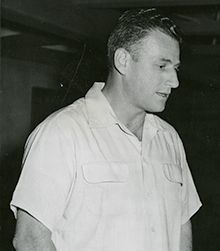
Stanley Kramer produced and directed 35 movies that garnered 16 Academy Awards and 85 Oscar nominations for him and his associates. Photos courtesy of the UCLA Film and Television Archive.
Scheduled to attend an invite-only, red-carpet reception hosted and funded by the Hollywood Foreign Press Association Friday night following the opening screening are many of those who appeared in his films, including Sidney Poitier (“Guess Who’s Coming to Dinner,” “The Defiant Ones”), Mickey Rooney (“It’s a Mad, Mad, Mad, Mad World”), Theodore Bikel (“The Defiant Ones”) and George Chakiris (“The 5,000 Fingers of Dr. T.”) as well as many luminaries who didn’t. Among them will be Louis Gossett Jr., Piper Laurie and Anne Jeffreys. At the event, Los Angeles City Councilman Tom LaBonge will present Karen Sharpe Kramer, the producer/director’s wife and an award-winning actress, with a proclamation honoring her late husband.

A cautionary tale about restless youths' challenge to the established order, "The Wild One," produced by Kramer, starred Marlon Brando as the head of a group of ruffian bikers who terrorize a small town. Theodore Bikel, Louis Gossett Jr. and Cara Williams are slated to attend the Aug. 10 screening.
“He gambled and proved that audiences would willingly purchase tickets to see well-made stories confronting real-world social concerns,” Kelley said of the film giant, whose 35 films won him and his associates 16 Academy Awards and 85 Oscar nominations. In 1961, the Academy of Motion Pictures Arts and Sciences gave him its highest honor, the Irving G. Thalberg Memorial Award, in recognition of the high quality of his film work.
“He also created an enlarged space for moral introspection in American cinema for the benefit of future filmmakers and audiences,” Kelley said. “This is a space in which new modes of dramatic and formal expression have also flourished, so that Kramer's contributions have enriched both public life and the American filmmaking tradition.”
Born in Hell’s Kitchen in New York City and raised by his mother, he graduated from New York University at age 19 in business administration. Trained in the studio system to fill a number of supporting positions, he held jobs that ranged from set furniture mover and film cutter to writer, editor and researcher.
After enlisting in the Army, he helped make training films. After World War II, Kramer got his big break when he returned to civilian life, found the studio system in disarray financially and decided to create an independent production company. Among his many movies are “High Noon,” “The Caine Mutiny,” “Ship of Fools,” “The Wild Ones,” “Inherit the Wind” and “Judgment at Nuremberg.”

Securing rights to Arthur Miller's hit play, "Death of a Salesman," was an early coup for Kramer. This new restoration, which opens the series, brings back to the screen a rarely seen Kramer film that disappeared from public view for years.
“For many years, it hasn’t been possible to see this important early feature produced by Kramer in a well-preserved print that is worthy of the material and the talents involved,” Kelley explained. The new restoration of the film was funded by the Film Foundation and the Hollywood Foreign Press Association.
In focusing on films that Kramer produced rather than directed, the archive is drawing the audience’s attention to his lesser-known role as a producer with vision and conviction, Kelley said. “The series points up his championing of important and provocative films — and talented writers and directors — from early in his career through the days at the height of his influence, when he directed and produced many brave and groundbreaking films. He might have made safer choices, but chose to make riskier, meaningful ones … and succeeded.”

With "Champion," Kramer provided a career-defining vehicle for actor Kirk Douglas. The film was also an important hit that helped build the reputation of its producer.
The attention the retrospective is getting reflects the public’s continuing recognition of Kramer’s significant contribution to American culture, Kelley said.
“Many folks respond with excitement when they see powerful connections between the work of film artists and the life we all share as citizens,” Kelley said. “Stanley Kramer’s legacy is a shining example that such an ambition is worth championing.”
____________________________________________________________________________________________
____________________________________________________________________________________________
To see a complete schedule of screenings, go here. Advance tickets are available for $10 at http://www.cinema.ucla.edu/programs/ticketing-information. Tickets are also available at the Billy Wilder Theater box office starting one hour before showtime: $9, general admission; free to all UCLA students with valid ID; $8, other students, seniors and UCLA Alumni Association members with ID.