
"A Portrait of Piotr Kajzer" (1944) is one of 114 drawings by Franciszek Jazwiecki that were created in the concentration camps.
That was the harsh reality for the mostly Jewish inmates of Nazi concentration camps during World War II who, despite facing severe punishment (or even death), created illegal art and either hid it or smuggled it to the outside world. These amazing artifacts included sketches, paintings, sculptures, jewelry — even a doll that was used as a hiding place for prisoners’ secret correspondence.  What makes "Forbidden Art" unusual is that it is part of a community collaboration between Hillel at UCLA and St. Alban’s Episcopal Church — next-door neighbors on Hilgard Avenue. The partnership began when the enormous exhibition cases arrived from the Auschwitz-Birkenau museum, and it was clear that Hillel would need additional exhibition space. This led Perla Karney, artistic director at Hillel’s Dortort Center for Creativity in the Arts, to reach out to the Rev. Susan Webster Klein, rector at St. Alban’s, to see if the church would be interested in sharing the exhibition. Klein agreed, and the artworks were split between the two buildings. Most of the panels are on display on the third floor of Hillel, while the remaining panels are exhibited in one of St. Alban’s assembly rooms.
  Presner teaches two Holocaust education classes at UCLA, including a Winter Quarter course that brings Holocaust survivors to meet with students to talk about their experiences. This opportunity for the students is more important than ever, Presner said, as most survivors are in their late 80s and early 90s and won’t be around much longer. "But the spaces will still be here. The spaces speak in a different way. You go into those spaces. ... It’s a very chilling experience."
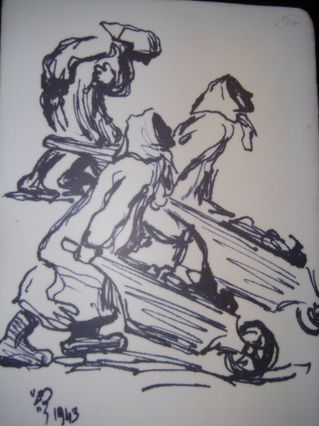
Several of these unique pieces can be seen in "Forbidden Art," an exhibition of photographs of camp art from the collections of the Auschwitz-Birkenau State Museum in Poland. On display through January at Hillel at UCLA and at St. Alban’s Episcopal Church next door, the exhibition features 20 panels showcasing large, color pictures of original art made by inmates of the Auschwitz concentration camp complex in Poland and of the Buchenwald and Ravensbrück concentration camps in Germany.
"Forbidden Art" will also be the subject of a Jan. 17 symposium organized by Professor Todd Presner, the Sady and Ludwig Kahn Director of the UCLA Center for Jewish Studies. Speakers will include representatives from the Auschwitz-Birkenau State Museum and the Auschwitz-Birkenau Foundation; Presner, who is currently writing a book called "A Message in a Bottle: Holocaust Writing on the Edge of Death"; and Lisa Saltzman, art historian at Bryn Mawr University. She will deliver the keynote address, "Images in Spite of All: Reflections on Art and the Holocaust." The symposium will be held at Hillel at UCLA at 4 p.m. and is free and open to the public; reservations are required.
The album from which this watercolor comes was a present from male prisoners of the Auschwitz camp to female prisoners of the Budy subcamp. An unknown author filled the notebook with personal greetings (1943-1944).
"There is a unique thing about the way it’s being shown here in Los Angeles," Presner said. "It’s a collaboration between a Jewish organization and a Christian organization, and it’s also a collaboration between a Polish organization and an American university. So it criss-crosses a lot of areas. ... It’s not just the domain of one group or organization or ethnicity or nationality; it’s a human history issue."
The exhibition and symposium are the first steps in what will hopefully be a long-term educational and research collaboration among UCLA and the Auschwitz-Birkenau State Museum and its foundation, Presner said. "This is very early in development, but what we’re hoping to do is send students over there to actually experience those physical spaces. ... The ability to go into those spaces, into the sites of destruction, is very powerful and important and transforming for the students."
"A Figurine of the Devil" (1941-1944) was manufactured in Auschwitz from ribbon and a piece of wire. With help from the Resistance Movement, the figurine was used to smuggle secret messages out of the camp.
But for those of us who aren’t planning a trip to Auschwitz any time soon, the exhibit provides a poignant look at life in the camps — the despair, but also the optimism.
"I think what was motivating the folks who created this art was an attempt to preserve something, to document something that they believed was important, that wouldn’t be documented any other way," Presner said. "That attempt was to try to make it live beyond the very precarious life that they were living right then and there."
________________________________________________________________
"Forbidden Art" is on display through Jan. 31 at Hillel at UCLA (574 Hilgard Ave.) and at St. Alban’s Episcopal Church (580 Hilgard Ave.). Viewing hours are Mondays through Fridays, 10 a.m. to 3 p.m.