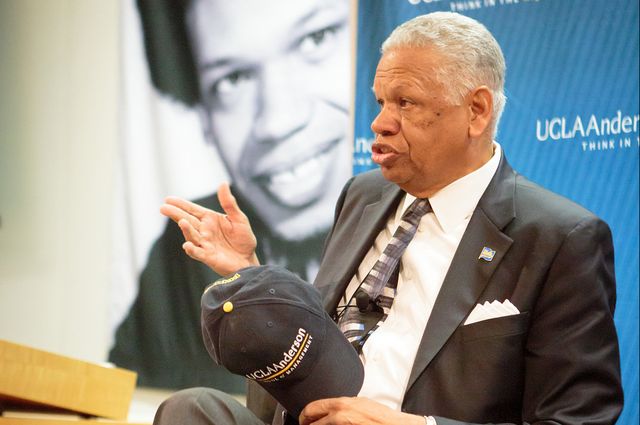
Wearing his signature ball cap and fashionable “statement” socks, Alfred Osborne Jr., senior associate dean and professor of global economics and management at UCLA Anderson School of Management, talked about his journey from a childhood spent in Panama to his 42-year career at UCLA in a recent conversation with UCLA Anderson Dean Judy Olian. The Tuesday, Feb. 13 event — the latest in the school’s Diversity Speaker Series — was co-hosted by UCLA Anderson’s African-American Students in Management and the Entrepreneur Association.
Osborne, who is considered something of a legend at UCLA Anderson, told Olian that he actually never expected to spend his career here. He had earned tenure at Anderson in the late 1970s, when he decided to join the Securities and Exchange Commission in Washington, D.C., as a Brookings Institution Economic Policy Fellow.
“I developed Potomac fever,” he confessed, but luckily for Anderson, Osborne didn’t land a job in the White House that he’d hoped for, and he returned to California.
Born to a naturalized U.S. citizen father — an educator from Antigua — and a Panamanian mother, Osborne grew up in Panama City, where his formative instruction was in Spanish. He joined the ROTC in high school in the Panama Canal Zone (“I loved medals being pinned on,” he remembered, grinning). During the Vietnam War, he was commissioned a second lieutenant in the U.S. Army Signal Corps but had what he called an “unspectacular” career that saw no combat.
He went on to earn four degrees at Stanford University: a B.S. in electrical engineering, an M.A. in economics, an M.B.A. in finance and a Ph.D. in business economics. Having begun his education in electrical engineering, Osborne had dreamed of returning to Panama to help improve communication infrastructure connecting the countryside to the city. But when he took his first economics class as a graduate student — Osborne returned to Stanford after working as an engineer set on a business career in what was to become Silicon Valley — it changed his life. “I finally understood what the world was all about,” he said.
That epiphany drove him to pursue the career that brought him to UCLA and, in 1987, gave life to the Harold and Pauline Price Center for Entrepreneurial Studies, a world leader in entrepreneurial education and research.
As founder and faculty director of the Price Center, Osborne is committed to investing in the human capital that will drive innovation and economic well-being. During his conversation with Olian, she mentioned his 1976 book, “Emerging Issues in Black Economic Development” (Lexington Books), and asked him what he thought was most current today that was true then. He responded, “The fundamental issues which give rise to poverty in underserved communities have not changed. Statistics don’t speak well to progress.”
Olian asked him what he would do to shape the model for change — not just in terms of increasing the numbers of people who have access to the tools for success but really changing how we get to a moment where places like Anderson really “look like the world.”
“We have to take a little chance on the margin and invest in what we’re looking for,” Osborne said. “We need to invest in human capital, even if it means taking a risk. Innovations are happening at the periphery of education that we have to pay attention to. You have to experiment at the margin of what you do best.”
Osborne advised students in the audience who aspire to be social entrepreneurs that, whether they pursue management roles in nonprofit or corporations, “think about it as your business. Be rigorous and disciplined about what you’re doing, add metrics to it.” He added that the new leaders in philanthropy — the Bill and Melinda Gates Foundation, for example — are disciplined about giving. “They want to see results,” Osborne said.
On the topic of leadership development, Osborne said that in the boardroom, he makes it his business to ask the questions on everyone’s minds that no one is asking. He speaks up when he sees others “losing engagement, when it’s awkward.” He said, “You’re better off if people can feel empowered. It’s better for the team. Otherwise, you’re just individuals not connecting.”
While he is revered for his expertise in entrepreneurship and new business development, Osborne said with humility, “I’m an accidental professor. I adopted economics as my lens for life and it has served me well.”
He encouraged the students,"If you see a need or recognize an opportunity for positive change, do something that adds value and leaves people better off.”
This story was excerpted from the original in the UCLA Anderson Blog.