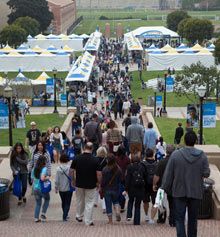
When Patricia Turner, UCLA’s new dean and vice provost of undergraduate education, stands before more than 4,000 prospective first-year students coming to campus April 13 for Bruin Day, she will welcome them as "the class of 2017," planting a seed in their minds for what will be well within their reach — graduation in four years.
The hope is that these potential Bruins will begin from Day One to visualize the path they will take to make that happen, said Turner. To help approximately 5,700 incoming freshmen make timely progress to Commencement 2017, UCLA Executive Vice Chancellor and Provost Scott Waugh, Turner and the deans of the College of Letters and Science have made it a top priority to provide a sufficient number of classes without sacrificing what UCLA has become renowned for: a high-quality undergraduate education.
A budget will back this up: To make sure there will be an adequate number of advisers, lecturers and teaching assistants, Turner said she’s anticipating receiving an increase in funding for instructional support.  "Making sure that freshmen in the new class of 2017 coming in this fall will have the classes they need to make timely progress to graduation in four years is among UCLA’s highest priorities," Waugh said.
Bruin Day starts prospective students thinking about what their four-year path to graduation could look like.
That’s not easy to accomplish at an institution of this size.
"Having enough courses for thousands of new freshmen that align with what they want and should take is an enormous statistical challenge that every large university faces," Turner said. "But I have been very impressed from the outset at how deeply committed everyone at UCLA is to meeting this objective. It’s not about fulfilling 70 percent or 80 percent of the need for classes. We’ve got to fill 100 percent of that need. People here take this very seriously and are working hard to meet this goal every day."
Current data from the UCLA Office of Analysis and Information Management show that the vast majority of UCLA students are getting the classes they need to graduate in four years (12 quarters). Of the students who entered UCLA as freshmen and graduated in 2011-12, 81 percent finished in 12 or fewer quarters. The percentage rises to 89 percent for those in the same class who graduated in 13 quarters or fewer.
In fact, the percentage of UCLA students graduating in 12 quarters has been rising in recent years and is at its highest point in university history.
"These excellent graduation rates provide clear evidence that the courses students need to reach graduation in four years are available to them," Turner said.
"When we look at students who do take longer than four years, the factors are not related to the availability of courses," the dean and vice provost said. "The most common reason why students take more than four years to graduate is that, along the way, they made a significant change in their major, decided to double-major or to add a minor. For some students, staying beyond 12 quarters is commensurate with goals they have refined here."
While Turner is confident that there will be enough classes for incoming freshmen to take as they begin to fulfill their general education requirements, that doesn’t mean that students will have their perfect class schedule. "Students should expect that they’ll be taking classes early in the morning and on Fridays as well. Classes here are offered throughout the entire week," Turner said, laughing.
Turner also is warning students not to feel frustrated or alarmed if they land up on a wait list for a class as adjustments are made before the final class count. "Our process is built upon the presumption that there will be students on a wait list. If you get on a wait list, there’s a good chance you will get into the course. Part of what goes into the formula to calculate how many seats we need to provide this year is last year’s wait list data."
She is encouraging incoming students to sign up for general education courses in the Freshman Cluster Program, an innovative, nationally recognized program where students explore a challenging, timely topic from a multidisciplinary approach.
"In recent years, there have been more openings in these award-winning courses. I would definitely try to take advantage of that," Turner said. She advises students to get beyond their comfort zone by sampling a subject area unlike any they have explored in the past.
From Bruin Day forward, students should begin thinking about what they want to have achieved by the time they don their cap and gown instead of planning their progress quarter by quarter, she said. To help students stay on track to graduating in four years, the College has plans to launch the Pathways to Commencement project sometime in 2014. Advising will be one component, but it will also involve a faculty review of curricula and opportunities for student internships and service-learning experiences, among other factors. Applying the knowledge they acquire in the classroom to these outside-the-classroom opportunities should be a priority for all, she said.
"Beginning on Bruin Day, students should start putting together their academic bucket list and mapping out a schedule toward completing it," Turner said. "Very few universities have the curricular and co-curricular variety that UCLA offers. I will be encouraging students to think ahead and start planning now."