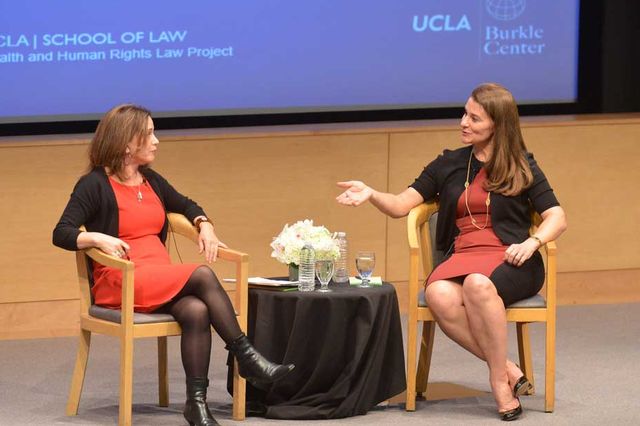
The Bill and Melinda Gates Foundation is betting big on women and girls to help developing countries lift themselves out of poverty, foundation co-chair Melinda Gates told a UCLA audience that filled Korn Convocation Hall on Nov. 5.
Gates sat down to talk with NPR’s Morning Edition co-anchor Renee Montagne at the 2014-2015 Arnold C. Harberger Distinguished Lecture on Economic Development of the UCLA Burkle Center for International Relations. Co-sponsored this year by UCLA’s Center for World Health and the Health and Human Rights Law Project of the School of Law, the annual event is intended to bring economic policy experts to discuss their views with UCLA students and faculty.
UCLA Distinguished Professor Emeritus of Economics Harberger, who founded and supports the lecture series, was in attendance. A pioneer in the field of development economics, he has trained scores of Latin American economists over his 30 years at UCLA, where he continues to teach.
Gates has worked assiduously to restore contraception to a major place on the global health agenda. Her efforts in this direction led to the 2012 London Summit on Family Planning, which brought together donors, national governments and the development community from around the world. The summit adopted the goal of providing contraception to 120 million women in the developing world by 2020.
Today, 15 developing nations have created national family planning action plans. “We funnel our money through those action plans,” said Gates, which includes support at both the policy and the project levels.
Yet, said the speaker, she quickly realized that contraception alone could not resolve culturally ingrained gender inequality. Soon she began to advocate a holistic approach to cultivate the “other half” of the population of developing countries and, in the process, reduce poverty levels and promote economic growth.
Gates’ focus on gender inequality has led the Gates Foundation to “bet big” on three core areas: health, decision making power and economic empowerment. Saying she saw incredible opportunities in these areas to change things for the better for women and girls, she emphasized that the contributions of many individuals to these causes could create palpable change in our lifetimes.
Gates went even further, saying that development as a whole needs to be looked at through a gender lens. She explained, for example, that agricultural projects often do not take into account that the primary farmers in many countries are women, who frequently seek to avoid cash crops because they lose power over cash resources.
Longstanding development data show that investments in women’s health and education lead to smaller families with healthier, better-educated children. Where women have economic opportunity and decision-making power over resources, more of those resources are also invested in their families, promoting overall economic development.
“We need men and boys in the conversation on all of these issues,” said Gates. Only by educating men first about how contraception and women’s access to economic resources benefit the health and well-being of their children and their wives, she emphasized can these things become culturally acceptable. Moreover, the way in which health education is delivered must be culturally appropriate and respond to gender-specific circumstances.
Focusing on solving today’s problems
The Gates Foundation, which has an endowment of $42 billion and has already disbursed over $30 billion in grants, is focused on solving contemporary problems of the present generation — and perhaps the next —, said the speaker.
The development aid provided by the foundation is not intended to endure indefinitely, noted Gates. Neither is the foundation itself. She and her husband do not expect it to have a shelf life much beyond their own — perhaps 15–20 years at most. “We want to spend our energy and our lives doing this work for the problems of today’s society,” she remarked.
“We are trying to build capacity now, so we can funnel more and more resources through those mechanisms,” she explained. “[And] as we learn what mechanisms work in one area, we take them and try to apply them to other areas.”
At present, the foundation is deeply engaged in the health sector in developing countries, supporting vaccination programs, building governmental and human capacity in health care, and developing ways to measure the impact of interventions, particularly those designed to improve gender inequality.
“The way that Bill and I think about this is that the only role [of] a foundation is to be a catalytic wedge,” said Gates. That is, foundations are able to take the risks needed to prove what does and doesn’t work. “But,” she added, “it takes government money to scale those things up.”
After helping create a global Vaccine Alliance (known as Gavi) and raising replenishment funds for it among wealthy nations, the Gates Foundation is now asking developing countries to make contributions to vaccination programs in their countries. Over time, these contributions are expected to increase until the programs become fully funded by those nations.
As a result of these programs, Gates noted that the governments of Ethiopia and Nigeria had built out basic-level primary health care systems in the form of “health posts.” (Ethiopia has built 15,000 such centers.)
“With basic supplies to help people and with basic trained health workers, usually two women, you can get unbelievable changes in maternal and child mortality,” observed Gates. The big lesson of the Ebola crisis is that investing in this primary level of health care provides an institutional bulwark against contagious diseases, which she predicted would continue to arise in perhaps more virulent form, she noted.
Nigeria, for example, was able to contain Ebola because after the first cases were reported, one of its polio clinics (supported by the Gates Foundation and the Centers for Disease Control and Prevention) was transformed into an Ebola emergency response clinic. Not only was the clinic able to trace the origin and spread of the disease in the country, the government was able to distribute appropriate behavior change messages throughout the system of health posts. In contrast, Liberia’s health system rapidly collapsed in the face of the Ebola crisis, having been greatly weakened by two decades of civil war.
Participating as an interlocutor, not an observer
Gates reflected that it was a great privilege to be able to travel for the foundation and learn firsthand about the concerns of men and women in the developing world. She traced her passion to making a difference in the world to the values of her parents, who encouraged all four of their children to attend college despite the serious financial burden this goal would impose.
A practicing Catholic, Gates said she attended a Catholic high school, but sought to transfer to an academically superior school in order to get into a good college. It took a while, she said, to understand that her parents sent her to the Catholic school because they believed in its values. “I was out serving in the courthouse ... in the hospital, in a school two miles down the road,” she remarked. “These very liberal nuns showed us that we could make a change in the world.”
Asked if she had gotten pushback from Catholics about her support for contraception in developing nations, Gates said she had received surprisingly little criticism from people of faith. On the other hand, she noted, push back from Rome had been expected.
Whenever she travels to a development conference, the speaker said she makes a point to stop somewhere in Africa and meet people on the ground to remind herself what the work is about. Similarly, she takes a day or two to decompress after long stays in developing countries to let the stories she has heard wash through her, experience the grief sparked by them and decide what she wants to do.
“You don’t go to these countries and not let your heart break,” she said.
This story appears on the International Institute website.