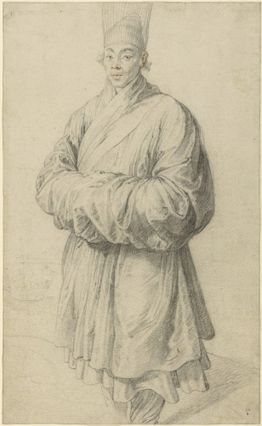

"Man in Korean Costume," about 1617, Peter Paul Rubens. The J. Paul Getty Museum
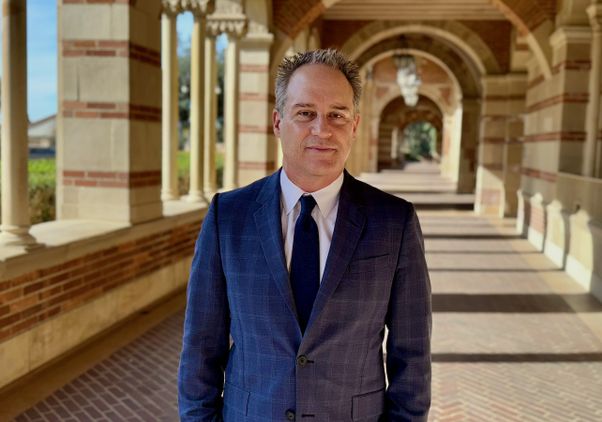
UCLA professor of art history Burglind Jungmann, who specializes in Korean art history, can add a little more detail about the east-west encounter depicted in the drawing as well as the artist’s intentions. She was one of several consultants to the curator of the Getty show and wrote an essay for the book published in conjunction with the exhibit, "Looking East: Rubens’s Encounter with Asia" (J. Paul Getty Museum, 2013).
"[The portrait] is certainly a European impression of ‘an Asian’ during Rubens’ times," Jungmann said. "Rubens did portraits of Jesuit priests who worked in China and who visited his studio in Antwerp. Therefore, he had direct access to some knowledge about East Asia.
"However," she cautioned, "we also have to be aware of his intentions. Rather than trying to draw an ‘authentic’ portrait, he created the image of an exotic Asian looking man whom he could use for a large altar painting." Jungmann spoke at a related symposium organized by the Getty Center on March 15.
To read the complete story, go here.
.