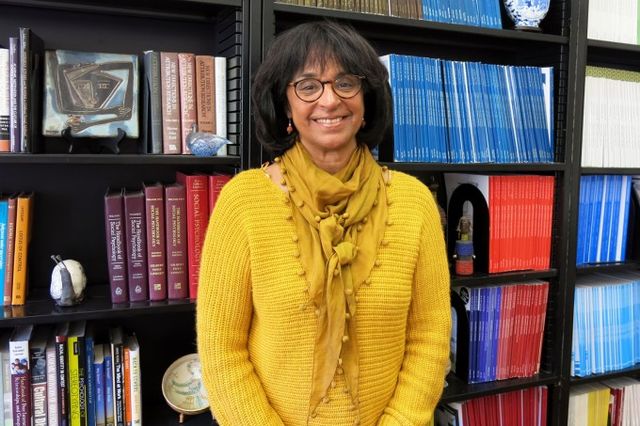
UCLA professor of education Sandra Graham has spent her career studying the effects of inequity in schools on the emotional, psychological and academic well-being of students of color. Now she is also having a direct influence on carrying out UCLA’s commitment to equity and diversity on this campus.
This fall, Graham, who is the UCLA Education and Information Studies Presidential Chair in Education and Diversity, took over leadership of the Council on Academic Personnel (CAP), a 14-member body within UCLA’s Academic Senate that is charged with maintaining standards and equity of the tenure and promotion process for faculty campuswide. CAP is responsible for reviewing all significant personnel actions involving employees of UCLA holding academic titles. And while its role, strictly speaking, is advisory, the opinion of CAP carries considerable weight.
Graham said that her position as a scholar of diversity and UCLA’s commitment to diversity inspired her to serve as chair of one of the most powerful committees on campus. A member of CAP for three years, she served as vice chair of the council during the last academic year.
“My presence on the council can help raise consciousness about diversity” noted Graham, who earned a B.A. degree in history from Barnard College, a master’s degree in history from Columbia University and a doctorate in education from UCLA. “We will help people realize that there are multiple ways to do research, and that the questions that you ask are sometimes different when you are concerned about challenges to people of color.
“When we evaluate someone’s research,” she explained, “what is really important is that it is peer-reviewed and is published in [reputable] outlets; work that addresses diversity is especially valued. In the last few years, CAP has been concerned about recognizing the value of doing diversity work and helping the university [to] fulfill its mission to serve a diverse population and work toward eliminating inequality.”
Dean Marcelo Suárez-Orozco of the Graduate School of Education and Information Studies praised her as “a scholar of extraordinary gifts and incomparable work ethic. With matchless grace, civility and brilliance, she is a one-person supernova. This historic appointment makes all of us at UCLA Education and Information Studies enormously proud and humbled to be her colleague.”
When Professor Graham is not busily evaluating faculty dossiers with her CAP colleagues — the committee meets 11 months of the year in order to meet its goal of reviewing 15 cases a week — she continues her research as a developmental psychologist. Most recently, she has been collaborating with UCLA professor of psychology Jaana Juvonen on the myriad challenges that face adolescents, including becoming a target of bullying both in person and online.
“Social media has really changed the way kids interact with one another,” Graham said. “It can be positive, and you can have lots of friends online … But it can also be bad for kids because there’s that anonymity that is associated with online [exchange], so kids can be very cruel in online environments.”
Graham said that physical bullying still occurs as well, although it tends to decrease slightly as children enter adolescence. She also underscores the particular effects of bullying as student populations become more ethnically and culturally diverse.
“The major predictor of being bullied is being different somehow,” said Graham. “It can be racial; it can be a disability, physical size or immigrant status. If you are different somehow from the ‘accepted’ way of being, you’re more vulnerable. And kids aren’t learning a lot of tolerance.
“That is why we are so interested in studying schools’ racial and ethnic diversity,” she said. “We believe that when there are more groups, there are going to be more norms and more opportunities to fit in and find your niche. And that is a better environment than when there is one exclusive group.”
A former middle school teacher, Graham said that schools and parents have to do their part in preventing bullying, but also strive to build children’s confidence when it occurs.
Research has shown that children are often unwilling to go to their teachers about bullying. “They don’t, because they don’t think the teachers are going to help them,” Graham said. “And a lot of times teachers think, ‘Oh, this is just part of the kids’ development; they’ll work it out.’ Or the kids will be seen as wimpy, because people will know they went to the teacher, and they are liable to be even more vulnerable to be picked on.”
Schools should never ignore bullying or assume that students are going to work it out, Graham said. And parents have to help their children realize that bullying is not just happening to them. “When children think bullying is happening to them and no one else, they’re going to blame themselves. Parents should tell children not to be afraid to speak up. Kids need to have that reassurance.”
Adolescent struggles are compounded when children encounter challenges associated with societal factors such as race, socioeconomic background or immigrant status, Graham explained. She is especially interested in what happens to minority adolescents who are going through the typical biological transitions of youth while also dealing with school environments where they are clearly a minority.
“For some kids, it’s easy to get through adolescence,” Graham said. “For other kids, all the physical changes [have] an impact on your relationship with your parents, your moods and the likelihood that you will hang out with deviant peers and engage in antisocial behavior. So, if you are in a school where you are accepted, where teachers like you, where the academic demands are appropriate for where you are developmentally, then you’ll be fine. But for many kids, that’s not true.”
Graham said that African American males are particularly vulnerable to stereotypes and discrimination, even by teachers and authority figures who may not realize that they are treating students unfairly, depending on their race or economic background.
This type of racial prejudice, which played itself out most dramatically in the Trayvon Martin case, comes from the preconceptions of black males — even young black males — as dangerous and threatening, she said.
This story was adapted from one on the Ampersand website.