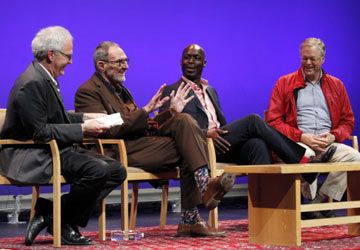
Great buildings can define a cityscape, but how much do the grand plans of architects influence daily life? Does architecture really matter?  A panel discussion on Monday at a conference on architecture sponsored by Zocalo Public Square and the Getty Center gave Thom Mayne, UCLA professor of architecture, the founder of Morphosis and an internationally recognized architect, and others in the field a chance to talk about why architecture matters and major challenges facing architects and planners today.
Renowned architect and UCLA professor Thom Mayne, second from the left, talks about why architecture matters during a panel discussion at the Getty Center.
In Los Angeles, said Mayne, architects find it difficult to be catalysts for cultural change. For one thing, no one with any political power cares about architecture, he pointed out. Culturally, the role of the architect in L.A. is to make pretty objects that people talk about. The architecture can only reflect the nature of the city’s values.
Another panelist, architect Válery Augustinof Dn/A, said it’s not the built form that makes architecture matter. It’s about "how a great space makes people feel — how we experience it every day." Good architecture, he said, provokes questions and makes people think differently about their cities.
"I think the architecture of the future," said Fred Kent, president and founder of Project for Public Spaces, "is about small-scale things," like the base of a building bringing the street around it to life.
"Your discussion is incrementalism," responded Mayne, "which is laissez-faire." The way cities are growing — and how large they are growing — is going to make for a more radical shift in what comes next for architecture and design.
In the question-and-answer session, an audience query about beautifying digital billboards turned into a discussion about what makes for a beautiful streetscape.
"We live in this radical, heterogeneous place," said Mayne. He drives down ugly Lincoln Boulevard in Santa Monica to get to work — but he said he finds Lincoln preferable to the sleep-inducing landscaped roads of Orange County that hide cars and buildings. "I really miss all that junky crap," he said.
Another audience member wanted to put in a word for iconic buildings like the Frank Gehry-designed Disney Hall, which has elevated the city. But Kent asked her to consider how many people sit out in front of the Disney Hall and use it as a public space.
Mayne said that Disney Hall and similarly ambitious buildings can be enjoyed simply as images that represent the city, whether or not they’re used as public spaces — especially in Los Angeles, which you see from your car.
Kent countered by polling the audience informally to find out if they were content to see the city by car, to which the answer was no. "If you created some life at the base of the Gehry building, it might be worth it."
Moderator John King, architecture critic of the San Francisco Chronicle, said he saw plenty of signs of life while walking around Disney Hall Sunday. The shops were busy, people on the steps were posing for photographs. "There were people there," he said, and "I didn’t get robbed."
To read the full coverage of this event, go here.