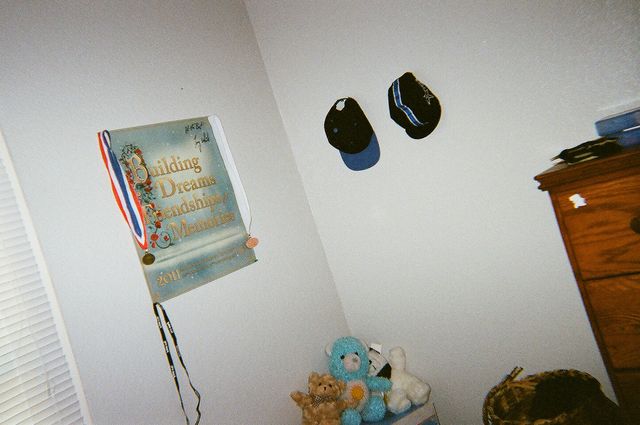
If a picture tells a thousand words, then the photo essays put together by former Los Angeles foster youth that detail their transition from living as a ward of the state to adult independence make up a powerful tale of tragedy and triumph.
In their recently published report, UCLA Luskin School of Public Affairs associate professor of social welfare Laura Abrams and Ph.D. students Susanna Curry and Laura Montero asked former foster youth and youth who spent time in the juvenile justice system to use photographs to tell the stories of their challenges.
This method of asking people to document their experiences in photos has been used in social research for several decades and can be particularly helpful when studying experiences that may be difficult to describe in words alone, the authors wrote.
“Young people who are making the transition out of foster care face many challenges and high risk of homelessness,” Abrams said. “These photos and stories reveal how important it is [that] young adults who are making this journey have safe and secure housing, as well as the support needed to launch their futures.”
In the United States, about 26,000 youth emancipate from the foster care system annually, the report stated. About one-third of these youths also have been in the juvenile justice system and are often referred to as “crossover youth.” Many of these young people face significant challenges in their young adult years, particularly in achieving economic independence and housing stability.
In order to better understand what emancipated foster youth go through, Abrams and her co-researchers focused on two questions: How do young adults who are exiting foster care describe their journey through transitional housing? And how do transitional programs shape young people’s perceptions of and movement toward independence?
In the final report, each participant, using a pseudonym, included photos that represent her or his past and present, along with brief comments.
Some photos are metaphorical, like the picture of a building in the midst of construction, which one participant described as “symbolic of the need for support when you’re trying to grow.” Kyle, 21, used a photograph of a yellow construction truck pushing garbage into a huge pile against a concrete wall to describe how he deals with problems. "But, um, life isn't like that. It was a crazy idea. It was like everything, like this trash, everything I don't use, negative thoughts or, um, hatred, you know?” wrote Kyle.
Others images are more literal, like the photo Rebecca took of an apartment she is now renting thanks to a great experience in transitional housing and a mentor who helped her.
“Our study demonstrates that former foster youth are extremely thoughtful and reflective about their experiences and the hurdles they face as they enter adulthood,” Curry said. “It is important that we pay attention to their perspectives in order to better understand what kind of supportive housing assistance is useful to them, what is not and why.”
Among the policy recommendations the report makes: fund programs that provide role models and mentors for young adults in transitional housing programs, in particular, adults who have successfully navigated this process; maintain an electronic resource list that includes key basic information about things like employment, housing, budgeting, transportation and a 24-hour hotline staffed by transition specialists.
Below are two examples from the report.
James
James is a 20-year-old African American young man who has great interest in music, reading and psychology. He entered foster care at age 6 and then was placed in Kin-Gap foster care with his grandmother from ages 13 to 18. When he turned 18, he left his grandmother’s house and ended up sleeping on friends’ couches for three or four months until he found a transitional housing program. He recently completed a nine-month internship, where he worked at an elementary school and then a thrift store. He hopes to get hired by the thrift store permanently.
This is a picture of a door that was smashed in during a burglary. James lived in this house as part of his transitional housing program, but was moved to a different residence after the burglary. His new residence has also been burglarized.
“It’s never really been safe. Ever since I moved there, ... there’s always been a problem with it getting broken into or somebody doing something strange to the house or something.”
In these photos, James illustrates his wish not to form deep attachments with others because he has been let down by people close to him throughout his life.
“I guess these two could be, but they’d have to go together, you know, one minute something’s there and the next minute it could be gone ... but the bus can represent anything in life, you know. Friends, family. You know, for me being somewhere and then not being there, and other people being in my life and then not being in my life.”
Jesuina
Jesuina is a 19-year old Hispanic woman. When she was a young teenager, she started “hanging out with the wrong crowd” and ended up involved in the juvenile justice system. Upon subsequent arrests, she was sent to a group home. After staying in the group home, she returned to her mother’s house. But her mother and she did not get along, and she ended up getting kicked out of the house. A few times she slept in the park near a local church. Jesuina feels that the people in her housing program are like a second family to her, and she is very grateful to have the guidance they provide to her. Her brother is also in the transitional housing program.
Jesuina explained that she had problems finding some resources upon turning 18 because she wasn’t a former foster youth. She said, “Some of them [transitional housing programs] are like strictly foster care and it's like you know foster care, okay, even though they didn't have parents or whatever the situation was, but like probation youth, it's kinda like the same thing. They don't really have parents because, you know, the parents are like, ‘Go. Leave me alone. You're just problems.’ They don't really get a chance anymore after they mess up when they're young. And then they're trying to get their lives together, but they don't really have like a lot of resources. Foster youth have more resources than just the probation youth.
“I just have my own space, to, you know, do whatever I wanna do. I'm just able to decorate it the way I like ... the bed they gave to me, with that little black drawer on the side? Little night stand, my mom gave it to me. That Clockwork Orange poster, my brother, he let me borrow it. I'm sure it's mine now, but my dream catcher, I bought it from the Dollar Tree.”
To read other participants’ stories and see their photos, go to the UCLA Luskin School of Public Affairs website.