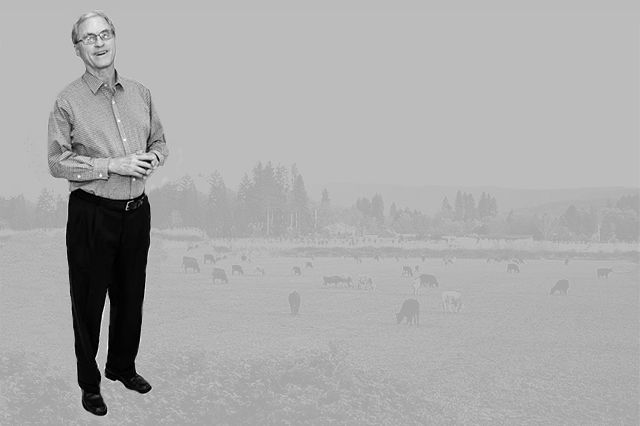
What does a young man growing up on a farm in Bend, Oregon (population 10,000 at that time), dream about? Just ask Robert Foster, adjunct professor of decisions, operations and technology management at UCLA Anderson School of Management and director of the school’s Global Access Program (GAP). Foster sheds some light on his journey to the ivory tower in a Q&A with the UCLA Anderson Blog.
How did that journey begin?
After milking two cows every morning and night and learning how to judge cattle as a member of the Future Farmers of America, my main objective in life was to leave the farm forever.
How were you planning to do that?
I was interested in cars and thought I’d be an automotive engineer until I found out that I would probably end up living in Detroit. The only school I applied to was Oregon State, as I was an in-state student and they accepted anyone who had a high school degree at that time. I never took any college admissions tests and was basically an average to poor student. The school’s dean of engineering suggested that I switch to another major. I declined. It took me five years to get my B.S. in mechanical engineering — something most of my students don’t know.
What did you do with that degree?
After a few regular engineering jobs, I discovered that, at best, I was going to be an average engineer. But I did find that I was able to quickly understand engineering problems and, more importantly, could “sell solutions” to executives. Thus became my future as a salesman of technology solutions. This led to eight years at Xerox Computer Services, ending up as vice president of marketing and sales of the $100 million cloud computing division of Xerox. I subsequently held several CEO positions at technology companies, including eight years at Thomas Bros. Maps, where in 1996 we published one of the first digital maps. Then I founded a startup, Ellison Robotics, and we robotically painted the M1A1 battle tank, cruise missiles and the Northrop B2 bomber. After seven years, I sold the company and became CEO of an early handheld computer company. The net of it is that mechanical engineering enabled me to quickly understand technology problems and then develop solutions to those problems.
Looks like your interest in travel transpired long before you took on the role of GAP director. How did that come about?
I got my first taste of international travel by joining the U.S. Coast Guard, which was also a way to stay out of Vietnam. While serving as an enlisted sailor, I had a chance to visit Mexico and Canada. Once I finished my military obligation, I was accepted at UCLA’s M.B.A. school and won an all-expenses-paid trip during the summer break to study international business in Europe, doing research in East Germany, Czechoslovakia and Hungary for a paper titled, “The Rebirth of the German Steel Industry After WWII” — all behind the iron curtain. I even went through Checkpoint Charlie.
After spending the next 20 or so years in the corporate sector, what prompted you to jump to academia and to UCLA Anderson in particular?
When I was a vice president of marketing for the time-sharing — now called “cloud computing” mdash; division of Xerox, I was the one of the early presidents of IS Associates, an executive support organization to the information systems department at Anderson. This was about 1983, and the then-director of the Applied Management Research (AMR) program asked if I would advise a few teams. That started my stint as a visiting lecturer, advising four AMR teams in 1984. I am still in regular contact with three students on these original teams and currently hold the record — about 100 — for the number of AMR field study teams I’ve served as advisor.
That started the part-time commitment to UCLA Anderson. When did you become a full-time faculty member?
In 1997, when I was still a part-time lecturer, students asked if I would create and teach a new course at Anderson that focused on high-technology business. Sounded like a great idea, so I created the first high-tech course here, which I have taught every year until last year, when I had to focus 100 percent on GAP. At that point, I had been teaching part time at Anderson for 15 years and was on my fourth company as a full-time CEO. I was getting burned out and wasn’t getting much personal satisfaction from the CEO role. I had asked Al Osborne (senior associate dean) and (then) Dean Bruce Willison if I could teach full time. Lucky for me, both said yes. I started full-time in the winter of 1998, teaching high technology management, business plan development and AMR field study. The best career move I ever made. I may be the first and only teacher at Anderson who started out as a visiting lecturer, was promoted to lecturer, then to senior lecturer and to adjunct assistant professor, then adjunct associate professor, and a few years ago to full adjunct professor — all of that without a Ph.D.
And how did that lead to the role as director of GAP?
I had advised some 100 AMR projects and served as a GAP faculty advisor for a couple of years, advising four teams of GAP students. When the first GAP director left to teach at another university, I was asked to become director of GAP. That was about 15 years ago.
What is it about teaching that you like most?
My favorite aspect of teaching is giving students the skills they need to be successful in their careers. That ranges from helping them make a compelling business plan presentation and conduct primary research for a new business or product to discovering ways to work in a small team to accomplish a challenging assignment. The most positive motivator for me? When a student calls or emails me years later and says, “Thank you,” or, “I remember what you said when I was your student.”
Any favorite moments in teaching?
Many of them, especially when I hear of the personal or career successes of a former student. I’ve been fortunate to receive several teacher-of-the-year awards at Anderson from the full-time, FEMBA and NUS students — which gives me positive feedback that my teaching was effective and appreciated. A recent highlight was being awarded a UCLA Distinguished Teaching Award, selected from the 4,000 faculty at UCLA. I am very proud to be the first non-tenure-track teacher from Anderson to receive this UCLA-wide award.
Another milestone of which I’m proud is being named one of the 100 outstanding alumni who have contributed most to Anderson. This, along with receiving the honor of Knight, First Class, of the order of the White Rose of Finland, which is the highest honor the government of Finland may present to a non-Finnish citizen, are certainly highlights of my career. The knighthood in particular illustrates the value the Finnish government places on that country’s long and positive relationship with UCLA Anderson and the Global Access Program, where more than 150 Finnish companies have participated.
This story was originally published in the UCLA Anderson Blog.