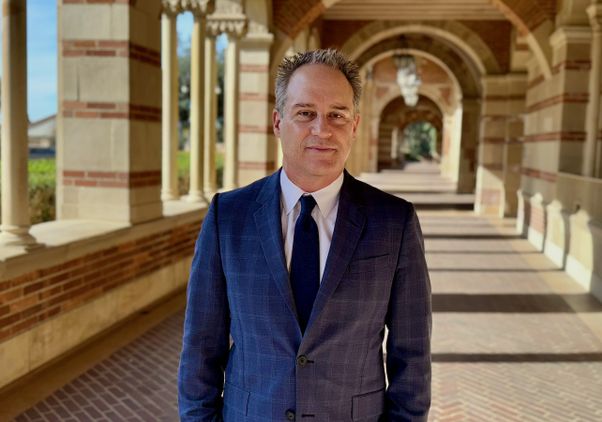
Renowned for his efforts to negotiate a peace accord with the Palestinian Authority at Camp David and Taba in 2000 and 2001, former Israeli Foreign Minister Shlomo Ben-Ami recently told an audience gathered at UCLA’s Schoenberg Hall that Israel should trim its post-1967 territorial ambitions and seek peace by achieving internationally recognized borders.
"What is required of Israel," Ben-Ami said, "is to strive to be on the right side of international legitimacy … The two-state solution has its faults and difficulties. But we have a message to convey to our own society: All other alternatives might be worthless and might put in jeopardy the entire Zionist project." Internationally recognized borders, he said, "will give us a pillar of security that we have discounted for so many years now."

Former Israeli Foreign Minister Shlomo Ben-Ami.
Ben-Ami served as Israel’s first ambassador to Spain from 1987 to 1991 and became minister of foreign affairs from 2000 to 2001. Apart from his diplomatic service, he is a well-known historian on the rise of fascism in Spain and a professor emeritus at Tel Aviv University.
"Historically," observed Ben-Ami, "Jewish experience in international relations [has not been] particularly edifying. An independent Jewish state existed for only short periods out of our millenarian history, and it twice committed political suicide. The reason was always the same: the blunder of ignoring political realities and challenging the world powers that governed the international system of the time."
Early Zionism, he maintained, was able to successfully create the State of Israel because it was pragmatic, valued world opinion and developed the diplomatic skills needed to navigate international waters.
David Ben-Gurion, founder of the modern state of Israel and its first prime minister, never stopped reminding his generation that Israel could never again conduct a foreign policy without an alliance with a superpower, said Ben-Ami. "It was not only through superior military capability that Zionism prevailed," he maintained. "Its victory depended no less on its sense of realism." Ben-Gurion, he insisted, was indifferent neither to the United Nations nor world opinion.
In fact, in an October 1960 speech before the Knesset, the Israeli leader explicitly asserted that without the sympathy of the world, Israel’s army alone could not provide it security. And, observed Ben-Ami, he remained doubtful of the ability a small Jewish state to survive in a hostile Arab neighborhood.
The legacy of the 1967 war
The Six Day War of 1967, in which Israel won a lightning victory over Egypt (the United Arab Republic), Jordan and Syria, ended with its occupation of the Sinai Peninsula, the West Bank, East Jerusalem, the Gaza Strip and the Golan Heights.
The war "reshaped the deployment of the superpowers in the region, created the conditions for the eventual dismantling of Soviet presence in the Middle East, shifted Israel's alliances from Europe to the United States, turned Europe into the major critic of Israel's occupation practices, put the Jewish state in the dock of the tribunal of public opinion, and opened new doors and avenues for the solution of the Arab-Israeli conflict."
But the Six Day War also led to a radical transformation of Israel from a conservative position to the policies of messianism, he said. Yet, he reminded the audience that the grand territorial designs of Zionism were tempered in Israel’s early days by a sober acknowledgment of the limits of power.
While the ideological settlers in Judea and Samaria like to defend "their messianic vision on the ground that Zionism was also an unrealistic dream that miraculously came true," Ben-Ami insisted that was not the case. "Zionism materialized because the historical conditions, the political circumstances, favored it. And because Zionist diplomacy wisely navigated through the waters of international diplomacy."
Israel in the dock of public opinion
The creation of Israel was greeted with widespread international sympathy, and its quest for security in a hostile Middle East was largely understood through 1967, said the speaker. Neither after the Arab-Israeli War of 1948 nor immediately after the 1967 war was Israel subjected to international pressure to relinquish its territorial gains, largely because of the perception that its victory was the result of a legitimate war, Ben-Ami explained.
But that was extremely short-lived, he pointed out. "When the ‘war of salvation and survival’ turned into a war of conquest, occupation and settlement, the international community recoiled, and Israel went on the defensive. She has remained there ever since."
Nevertheless, he found Europe’s harsh criticism of Israel during the second intifada in the Palestinian territories [roughly 2000 to 2005] unbalanced, especially in light of the good-faith efforts of Israel to negotiate a reasonable solution to the Israeli-Palestinian conflict in 2000–2001.
"We, the Barak government," said the speaker, " ... negotiated peace by coming close to the outer limits of our capacity for compromise. We touched and broke all the taboos of our collective existence. We accepted the division of Jerusalem, we committed ourselves to the practical withdrawal from the [Palestinian] territories and the creation of a fully viable Palestinian state." Yet, despite the concessions made by Israel and the unlikelihood that a similar team would be in power in Israel for years to come, Ben-Ami said he saw no sense of urgency or missed opportunity among his Palestinian interlocutors.
"We came as close as possible to breaking the genetic code of the Arab-Israeli conflict, and Europe applauded us. However, the moment the intifada started, the onus was almost exclusively put upon us," he remarked. Instead of using its economic, political and moral leverage to influence the Palestinians, Ben-Ami maintained, Europe primarily criticized the supposedly excessive force that Israel used in its defense.
"Europe," contended Ben-Ami, "which too frequently looks at us with an air of sanctimonious finger-waving, knows from experience how deep such conflicts can become. It took Europe many religious wars, two world wars and more than one genocide to solve its endemic disputes over borders and nationalisms."
Looking to the future
Ben-Ami said he remains optimistic about Israel’s future. It is up to the country’s leaders to show us "that we have not survived all the horrors of extermination only to entrench ourselves behind the walls of our own convictions and remain there, righteous and immobile," he asserted.
"I truly believe that not all is lost," concluded Ben-Ami. "Israel has still much to say to the international community and, if it goes to internationally recognized borders, it will have peace with the world." History and memory may remain a bone of contention between Israel and many nations, he said, but that should not be an obstacle to peace.
________________________________________________________________________________________________________
To read the entire story recapping his speech, as well as to view the videocast, go to the International Institute’s website.