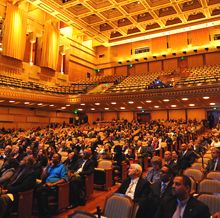
Braving intermittent rain, hundreds of people — representing all facets of Winston Doby’s 40-plus years in university service — came together on Jan. 23 to celebrate the life of a legendary champion of student diversity and access who left an indelible impact on this campus, the University of California system and the lives of generations of students.
An impressive roster of leaders and dignitaries, led by Chancellor Gene Block, gathered at Royce Hall to highlight before more than 700 family members, friends and colleagues what this visionary leader and vice chancellor emeritus for student affairs meant to them. Doby died Nov. 10 in Los Angeles at age 71 of cancer.
Among the long list of people taking turns at the podium to speak movingly about Doby’s many contributions were Chancellor Emeritus Charles E. Young; Los Angeles Mayor Antonio Villaraigosa; the presidents of the California Community Foundation and the Los Angeles Urban League; the chair of the UCLA Black Alumni Association; former student body president Jasmine Hill; former Graduate Division Dean Claudia Mitchell-Kernan; and Dean Aimee Dorr of the Graduate School of Education & Information Studies.
"This program should take several days and include literally hundreds of people to barely start to cover accurately his impact and his legacy," said Vice Chancellor of Student Affairs Janina Montero during her tribute to her friend and colleague.
They spoke of his devotion to students and young people, his focused dedication to educational equity and his success at helping students overcome so-called insurmountable barriers to college.
"His greatest contribution may have been his impact on UCLA’s leadership in diversity, which could not have happened without his tireless efforts and his ability to make a case for access without polarizing polemics," Chancellor Block said. Instead, Doby relied on logic, solid facts and his gift of persuasive reasoning to gain people’s cooperation.
In fact, Block said, Doby’s greatest gift was his ability to motivate people to follow "the better angels of our nature" to face challenges and overcome hurdles.
Just two years after Doby, a UCLA alumnus, started his career on this campus as an assistant track coach, he became director of special education programs and established UCLA’s esteemed Academic Advancement Program (AAP). More than 40 years after its founding, AAP is emulated by other campuses as a national model for providing support to college students from historically underserved populations.
As the vice chancellor for student affairs, Doby was not only a prominent leader on campus, but also chaired high-level task forces on a systemwide level that helped revamp policies and practices in admissions, outreach, student services and student financial support, among other areas.
To the wider community outside of Westwood, he worked with the Los Angeles Unified School District, community organizations and area leaders to promote academic achievement. When he eventually left UCLA, he joined the UC Office of the President as vice president for educational outreach and, later, student affairs.
"When Proposition 209 passed, and affirmative action was dealt a severe blow, Winston redoubled his efforts to increase the number of young people of color at UCLA," said Villaraigosa at the memorial. "He didn’t give up. And when the university faced a crisis, a decline in African-American enrollment in 2006, Winston was a key force in uniting a coalition of community organizations and churches and pushing the university to address this issue."
Young recalled the rocky years when student diversity was being challenged at the ballot box through Proposition 209, and its advocates were insisting that diversity would make the educational program less effective. "There was no more constant, committed, sane, reasonable voice for all of us during that period of time than Winston Doby’s. … Winston worked hard to make UCLA a diverse campus, an open campus to all who could benefit from it. … One of the things Winston and I and our colleagues understood was that you couldn’t be a great university in this day and age unless you were diverse." To conclude his remarks, Young sang an old Presbyterian hymn in honor of Doby’s own Presbyterian roots.
Blair Taylor, president and CEO of the Los Angeles Urban League, took the opportunity to announce that his organization’s highest award — given annually to an individual who crosses ethnic and racial boundaries to create great partnerships — had been renamed in Doby’s honor. He added, to enthusiastic applause, that the recipient of the first Winston Doby Community Coalition Partnership Award was Mayor Villaraigosa.
More than one speaker mentioned Doby’s unique ability to get people involved in community service, almost without their realizing it. Ben Van de Bunt, executive vice president, principal and director of Guthy-Renker Corporation and a former UCLA undergraduate student body president, recalled how his friend could get him to do just about anything simply by asking a question.
"Have you ever thought of an internship program?," Doby once asked Van de Bunt during a golf outing. "Every time Winston would ask me a question, I knew it was going to cost me a lot of time and a lot of money, and I was going to feel fantastic about it when it was over. So I stopped questioning," Van de Bunt said, laughing.
Between the reflections, there were two musical interludes: a guitar solo of the song "Remembering" by Ethnomusicology Professor Kenny Burrell, and a performance of one of Doby’s favorite songs, "Misty," by Broadway actress Eloise Laws.
Monica Doby spoke on behalf of the Doby family, recalling the selfless acts that her father instilled in her and her brother, Chris. "My dad lived his entire adult life in service to others, constantly seeking ways to not only continue to pay it forward, but getting others to see the value of passing on that help. When I think of all the outpouring for my dad, I can’t help but think of the exponential growth that paying it forward truly has. If not for that scholarship he received — that he was pushed forward to by Bill Thayer — he might not have had the chance to grow into the man that he became right here at UCLA."