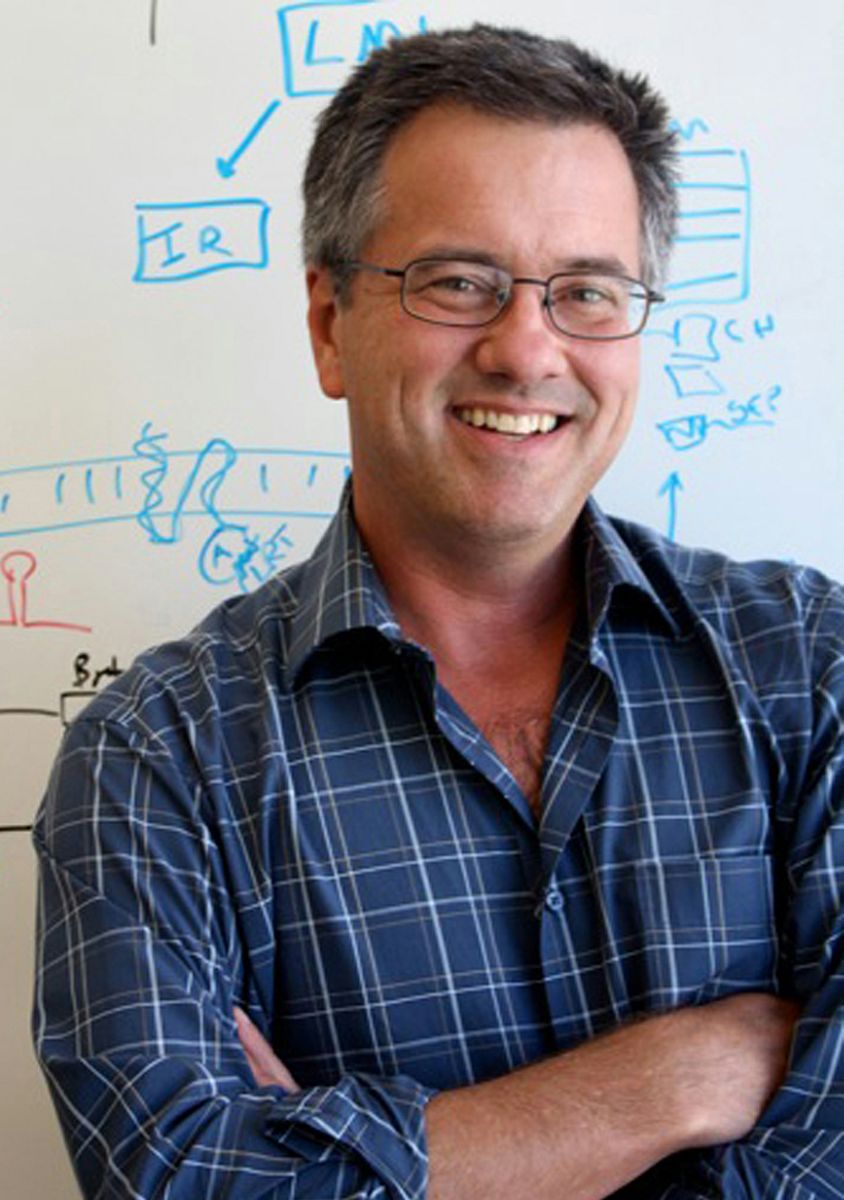
Jeffery F. Miller, a professor in the Department of Microbiology, Immunology and Molecular Genetics, has been appointed director of the California NanoSystems Institute (CNSI) at UCLA, effective immediately, UCLA Executive Vice Chancellor and Provost Scott Waugh announced today.
Miller has also been named the Fred Kavli Chair in NanoSystems Sciences, which is funded by the Kavli Foundation. He is an active member of CNSI, working in the areas of protein evolution and precision antimicrobials.
Miller most recently held the M. Philip Davis Chair in Microbiology and Immunology. He has also served as department chair since 2002. He was associate director of the Pacific Southwest Regional Center of Excellence in Biodefense and Emerging Infectious Diseases and is a past chair of the General Meeting of the American Society for Microbiology. A former Pew scholar in the biomedical sciences, he has been elected to the American Academy of Microbiology and the American Academy of Arts and Sciences.
In 2004 he co-founded AvidBiotics Corp., a biotherapeutics company in South San Francisco, and recently co-founded another venture focused on nanotherapeutics for skin disease. In 2009, Miller was appointed by the U.S. secretary of health and human services to the National Science Advisory Board for Biosecurity, for which he serves as a voting member. In July 2012, he became president of the American Society for Microbiology, which represents 40,000 members in more than 73 countries.
Before joining the UCLA faculty in 1990, Miller was a postdoctoral fellow at Stanford University School of Medicine. He earned his Ph.D. in molecular biology from Tufts University School of Medicine and his bachelor’s degree from Case Western Reserve University.
Miller's laboratory studies molecular mechanisms of bacterial pathogenesis and the evolution of functional diversity in bacteria and bacteriophage. His research group comprises graduate students, postdoctoral fellows and senior scientists with expertise in bacterial genetics and genomics, cell biology and imaging, small molecule screening, conventional and germ-free animal models, and neonatology and infectious diseases. His laboratory has received funding from the NIH continuously for nearly 25 years, as well as support from the American Cancer Society, the U.S. Department of Agriculture, the Pew Foundation and the Department of Defense’s Defense Threat Reduction Agency.