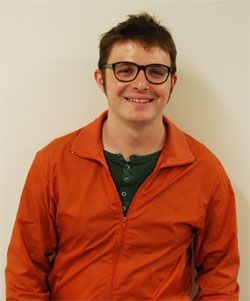

Patrick Adler, an urban planning graduate student, found his study featured on the NFL Network.
Adler found that, when it comes to producing football players, the Louisiana triangle region of New Orleans, Monroe and Lafayette is home to a disproportionately large number of NFL players.
An urban planning doctoral student at the UCLA Luskin School of Public Affairs, Adler saw his study featured on the NFL Network on Jan. 28 as host Brian Unger tried to unravel the "Bayou Effect" that finds a disproportionate number of NFL players that rather obscure part of the country — including four from Boutte, La., with a population of 3,000.
Adler conducted his study during his free time between a busy class schedule and his dissertation, combining his love of urban planning and the NFL to look through every NFL roster prior to the 2011 season. Breaking down the geographic variables of where every player hailed from in the United States, he discovered a highly disproportionate amount of players coming from the New Orleans and Louisiana area.  Large metropolitan areas, based on population alone, would seem to have the most NFL players, and Adler’s study confirmed that: The vast net of Los Angeles leads the NFL in players per metropolitan area.
"I’m always doing little projects on the side, and I guess the theme is establishing geographic patterns in the cultural economy," Adler said. "You think about talent, which is a big topic in economic development. Where a firm is located dictates where a place would have jobs and money and development. More and more, it’s where people go, in explaining the success of some places. How do cities, for instance, get talented people to live in their cities?"
Map of Adler's "Bayou Triangle: findings, created by Zara Matheson, Martin Property Institute.
Yet the triangle region of New Orleans, Monroe and Lafayette produced 67 players, and the greater Louisiana region had 91 players. When broken down on a per-capita basis, that small area accounted for about four NFL players per 100,000 people, which was one of the highest in the nation.
Adler, a native of Albuquerque who earned his undergraduate and graduate degrees at the University of Toronto, completed his study nearly a year ago and saw it published online in The Atlantic Cities, an Atlantic magazine offshoot that sports the tagline "place matters." The NFL Network recently found the study and then found Adler.
"It’s nice because you put something out there on the Internet and at first, it seems really fleeting," he said. "It’s out for a week, and people say ‘cool,’ and that’s it. You forget that things are on the Internet forever."
Rather than just turning to city-by-city listings of every NFL player, Adler used a sample size of 2,723 total players — about 85 per team — and then broke down the area of the country the cities were in. For instance, rather than just saying an NFL player hailed from Long Beach, Calif., that would fall into the Los Angeles metro region.
"The NFL data is in a player’s hometown. You could only automate so much. It’s a lot of just going through 30,000 data points," said Adler, who, despite his love of football and his ability to atract big-league attention, plans to become a professor of urban planning or — perhaps not surprisingly — geography when he completes his Ph.D.