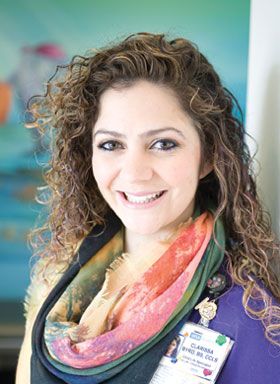
Clarissa Byrd, a certified child life specialist at Ronald Reagan UCLA Medical Center, brings comfort and understanding to children who are experiencing stress or trauma in the hospital’s emergency department.
What is the role of a child life specialist in the emergency department?
We use purposeful play to help children feel safe, to understand what’s going on, to be prepared for upcoming procedures and to experience some joy in a not-so-joyful place. When a child is in a medical emergency, I am at the head of the bed, supporting him or her by using reassuring words with accurate sensory information to help them cope while the medical team is working around and on them. I use calming diversion and comfort techniques to help soothe anxious and frightened patients and their parents.
I work with children of all ages, from infants to adolescents, and try to see every child in the emergency department (ED), if possible. Sometimes I work with children of adult patients in the ED, providing support when issues arise with an ill or injured parent, or bereavement support if needed. Another part of my job involves educating medical staff on communicating with kids and making the ED as “ouchless” as it can be.
What kinds of activities do you provide for children?
What I do depends on the child’s needs and how they are coping. If a child is comfortably lying in bed with his parents, I might bring in a movie or a coffee for mom or dad. But I can spend hours with a child, especially if it is his or her first time in the hospital, educating and preparing them for all that is new and scary. I might show a child pictures of an MRI machine on my iPad and talk about how it looks like a donut, then play some of the sounds they will hear. Sometimes I do medical play so a child can experience a little role reversal such as poking a doll the way she’s been poked by a nurse for an IV. The power of play in a traumatic situation or stressful environment is such a relief for kids. It also gives us insight into the child’s experience, so we know how to help the child cope.
How do you establish a connection with children?
When I enter the room, I immediately assess the energy of the room, what’s going on among the child, the parents and whoever else is in the room. I think of myself as a performer who can change the environment by bringing in a playful or calming presence. I have many tools and tricks that I use to connect with children and to provide a diversion during procedures. I almost never leave my office without bubbles, an "I Spy" book, my magic wand and a special flashlight that makes animal noises. The iPad is an amazing distraction tool, but I try to use others if I can. If I run out of tricks, I’ve been known to break into song.
What do you love most about your job?
My job is different every day. I never know what to expect. But I love working with kids. They are such good teachers. They take life moment by moment. Some kids are here with horrible illnesses, but you would have no idea they were even sick. Their resiliency makes me appreciate life every day.
How did you become a child life specialist?
I worked as a professional actress and singer in musical theater when I was a child and young adult. When I was a senior in high school, several friends were diagnosed with cancer, which really shook me up and opened my eyes to the medical world. I was accepted into Julliard but realized I didn’t want the New York lifestyle and decided to pursue a profession that would allow me to help others. I always loved working with children, so Child Life was the perfect place for me.
What are some of your outside interests and hobbies?
I spent part of February in India on a medical mission with a group that sets up a health clinic in a small village for two weeks every year. I was responsible for the clinic’s playroom. I also teach parents infant massage, which builds parent-child bonding and helps premies grow and heal faster. Other activities I love include hiking, spearfishing, surfing and paddleboarding. I’m also the singer in an ’80s cover band that does music by artists like Madonna and the Go-Gos.
This article originally appeared in UCLA Health Employee News.