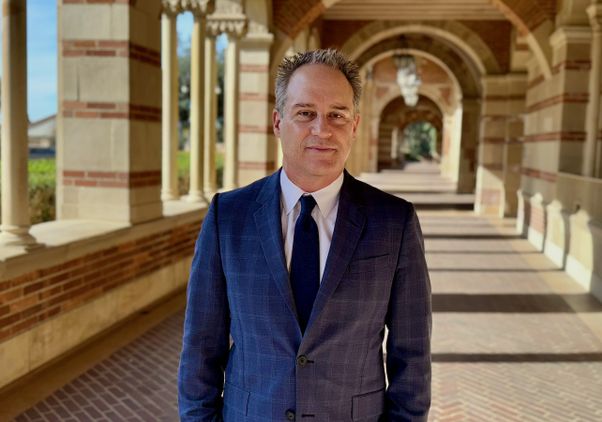
 Juan Matute is the director of the UCLA Local Climate Change Initiative at the Luskin School of Public Affairs. He studies how to transform notoriously car-dependent cities like Los Angeles into cleaner, greener, but still useable public-transit hubs. Debra Yoo from UCLA's Be A Green Commuter blog asked him a few questions about climate change, transportation and what we can do about it.
Tell us about the Climate Change Initiative at Luskin.
The UCLA Local Climate Change Initiative does research to support California’s transition to a low-carbon economy while enhancing our quality of life. One of our next projects will look at walkability, bikability, job access and transit access in different neighborhoods in the Los Angeles region. We want to identify neighborhoods where it’s relatively easy to live a car-light or car-free lifestyle.
Do you have any recent projects at Luskin that you can tell us about?
I recently released a report on hidden incentives that keep Californians driving, even if they’d rather switch to other modes. While many policies may seem innocuous, they end up spreading out cities (leading to greater trip distances and less walking), reduce demand for other transportation options (such as carshare and carpool) or strip some of the potential cost savings from those who don’t use automobile infrastructure.
You're referring to "Unraveling Ties to Petroleum: How Policy Drives California's Demand for Oil," a report that you worked on with Professor Stephanie Pincetl from UCLA’s Institute of the Environment and Sustainability. What did you conclude were among the worst policies encouraging Californians to keep driving?
We noted that some policies hide the true cost of providing automobile infrastructure. For instance, minimum parking requirements on new buildings create implicit user-subsidies, and also increase the number of parking spaces per acre in dense areas, with more parking spaces per acre leading to more traffic congestion. In addition, employer parking subsidies hide parking costs from employees without always offering non-drivers a similar subsidy. Adding high-occupancy vehicle (HOV) lanes is good, but the conventional approach of adding them through construction, rather than conversion of existing lanes, delays the implementation of HOV networks. Even policies that aren't obviously car-related have an impact. The home mortgage interest deduction may contribute to larger homes and larger lot sizes, and the location of state enterprise zones far from population centers may force workers to accept longer commutes.
What kind of role does transportation play in climate change?
Transportation is the largest source of greenhouse gas emissions in California. Successfully reducing the state’s greenhouse gas emissions will require substantial changes in how we get around each day. In the future, we’ll see far greater levels of walking for neighborhood trips than we currently do. This means substantial changes to the transportation and land use system will occur over the next few decades in order to make walking the preferred mode for more trips.
How do a person’s transportation choices factor into climate change?
California can set an example for how a rich, auto-dependent economy moves beyond high-energy transportation modes toward a more sustainable means of getting around. UCLA has one of the oldest and most studied alternative commute programs in the country. By using discounted transit passes, biking, walking and even paying for parking rather than receiving it for free, UCLA students, employees, and visitors have managed to make commuting to UCLA far less energy and traffic-intensive than it would otherwise be.
How do you commute to campus each day, and what’s your favorite aspect of it?
I either bike or take the bus to campus. I really like to watch The Colbert Report on the bus, because it makes my commute experience orders of magnitude better than sitting in a driver’s seat, waiting for a queue of cars to get onto the freeway so that one person occupying 300 square feet of space can sneak under the 405.
What can members of the UCLA community do to support Luskin’s work on climate change?
Follow @UCLAClimate on Twitter and respond to the U.S. Census Bureau. Policy researchers love data.