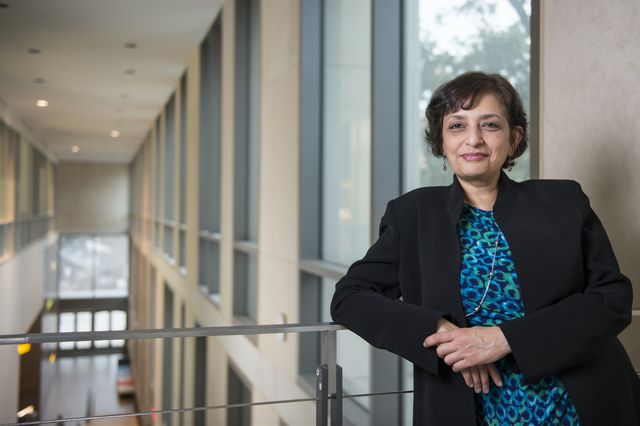
Jayathi Murthy, chair of the mechanical engineering department at the Cockrell School of Engineering at the University of Texas at Austin, will serve as the next dean — succeeding current dean Vijay Dhir — of the UCLA Henry Samueli School of Engineering and Applied Science, starting January 2016. Prior to UT Austin, Murthy was a professor at Purdue University and Carnegie Mellon University, and she previously worked in industry. She earned her Ph.D. from the University of Minnesota.
How did you become interested in engineering?
I am the daughter of a civil engineer. My father belonged to the first generation of engineers to graduate after India’s independence. He built the first railway bridges in some of the most remote and desperately poor parts of that fledgling nation. As a child, I lived in those places — no running water, no electricity, no hospitals, no schools … My father’s work utterly transformed these places. Engineering has the power to transform lives. This is why I am an engineer.
What, in your view, is the role and responsibility of engineers?
Engineers must use their skills, knowledge and creativity to address the most pressing technological problems facing society — problems with energy, water, food, health and the environment — and to do it in a sustainable, ethical and humane way. Engineering schools must give students hard technical skills, but also breadth. Students must be able to appreciate the social, historical and political contexts in which they practice their profession so that they can make real impact.
What opportunities and challenges are ahead in engineering education?
I believe engineering education is in a period of extraordinary transition. India and China together will graduate over a half million engineers this year. The U.S. will graduate about 80,000. How do we maintain our historical leadership in engineering education and research in the face of all this competition? Our response to this challenge must play out in a time of severe financial constraints. Inflation in higher education has been between 5 and 10 percent a year. Meanwhile, middle-class wages are stagnant and state appropriations are falling. So it is a real challenge to provide high-quality education at an affordable price.
Then there are enormous transformations being wrought by technology — witness the huge excitement about online education. Some have claimed this will make traditional brick-and-mortar universities irrelevant. Whether that comes to pass or not, I have no doubt there are huge opportunities to transform the way we teach engineering, and even who we teach it to.
Another challenge for us is to create academic structures that are frictionless, that allow creative interactions to flourish across the university.
And then there are demographics. Our country is undergoing big demographic shifts, and some groups are not well represented in the engineering enterprise. We need to ensure that the promise of engineering education is accessible to all our citizens.
What is your vision for UCLA Engineering?
I think of UCLA as one of the “public Ivies.” One the one hand, like the Ivies, UCLA Engineering does cutting-edge research and supports a large research infrastructure. On the other hand, it is our charter to deliver high-quality engineering education to a much larger student body than any Ivy does. I believe our greatest contributions lie in a creative merger of these two aspects. Our location in L.A. — the gateway to the Pacific Rim and to Latin America — gives us an enormous advantage.
Specific initiatives I have been thinking about include growing the size and quality of our research enterprise, broadening our undergraduate curriculum, expanding our international footprint, growing our online and executive programs and achieving greater diversity.
I want to say how lucky I am to be building on what Dean Vijay Dhir has accomplished already.
Please describe your research interests.
I started my career in computational fluid dynamics, devising algorithms for simulating fluid flow and heat transfer for industrial applications — to determine, for example, the aerodynamic performance of cars, how much your laptop will heat up, etc. Over the last few years, I have been working in the area of nanoscale heat transfer. Recently, I have also become very interested in merging decision sciences with engineering simulation and experiments — I believe this effort is essential if simulation is to be embedded deeply in industrial practice.
Please describe your accomplishments in research and education.
The early third of my career was spent in a startup called Fluent Inc., today a world leader in commercial fluid dynamics software. I was one of the earliest employees of Fluent, and my algorithmic work undergirds many of their software products today. My work is used the world over, and this is a source of great pride and satisfaction for me.
In academics, I believe I’ve made important contributions to the development of computational algorithms for nanoscale transport. I was the director of the the Center for Prediction of Reliability, Integrity and Survivability of Microsystems — the PRISM center, funded by the National Nuclear Security Administration. We made significant strides in developing uncertainty quantification frameworks for microsystem simulation.
I love teaching, and am always tinkering with my courses and experimenting with new ways to get my ideas across.
But the greatest sources of pride for me have been the spectacular initiatives the faculty has led during my time as department chair at UT Austin. These are truly creative efforts by faculty to expand hands-on learning, develop innovative online courses and materials and promote a diverse student body.
This story originally appeared in UCLA Engineer magazine.