Haydee Licari, a teacher of Spanish and English as a second language at Dana Middle School in San Pedro, has seen current immigration trends reflected in her classroom. In recent years, her student population has shifted from being primarily of Mexican heritage to being increasingly of Central American, Filipino and African heritage.
That’s part of the reason why she decided to enroll in a workshop last month on the history, politics and culture of Central America, along with 19 other K-12 teachers from the Los Angeles Unified School District (LAUSD). “This workshop was the missing link in my education,” said Licari, a teacher since 1989 with a master’s degree in education and school administration.
Combining presentations given by professors from universities across California and lively discussions, the intensive six-day workshop held at Bunche Hall was organized by the UCLA Latin American Institute (LAI) with funding from a Title VI federal grant of the U.S. Department of Education.

Teachers use black beans, maize kernels and toothpicks to solve a series of Mayan number exercises. Photo by Cynthia Gomez.
Based on census figures from 2010, 3.1 million Central Americans live in the United States — with Los Angeles County hosting the largest number of these immigrants. The rapid growth in the population of Central Americans over the last four decades has been driven largely by increased immigration from El Salvador, Guatemala, and, more recently, Honduras. They immigrated to the United States, first, as a result of political repression and civil war, and, later in greater numbers, for economic reasons.
More than half of the teachers who attended the summer institute have been teaching in L.A. public and charter schools for more than 14 years. Many teach multiple subjects in elementary school, but several are social studies and language arts teachers; one teaches biology.
Veteran LAUSD teacher Georgina Salazar, who teaches Spanish in the humanities magnet program of Hamilton High School, has attended two previous teacher workshops sponsored by LAI and now plans her summer vacations around them. “This is a really great program,” she said, “I hope it never ends!”
A rich and complex history
The workshops exposed the teachers to diverse topics ranging from Mayan civilization and colonial history to Central American folklore and U.S. foreign policy in the region. The lectures progressively revealed a region with a highly diverse and accomplished pre-Spanish culture that has been obscured by the impact of Spanish colonization, U.S. economic dominance, the exigencies of the Cold War and economic globalization. The denigration of indigenous cultures, from the burning of Mayan books by the Spanish conquistadors to the outright genocide of Mayan people in Guatemala in the 1980s, continues to affect how Central Americans perceive themselves to this day, lecturers pointed out.

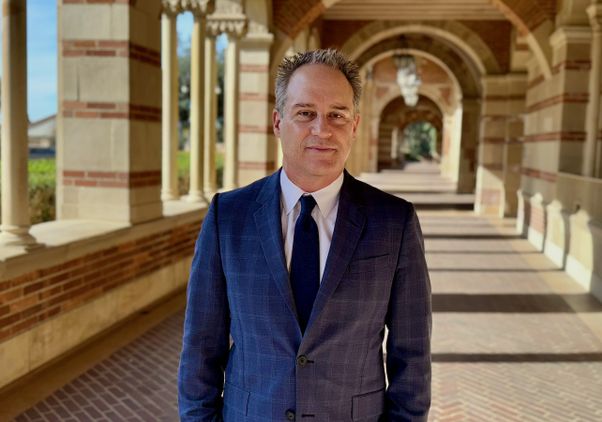
Kevin Terraciano, a UCLA history professor and director of the Latin American Institute, talks about what happened to indigenous groups in Central America with the arrival of the Spanish conquistadors. Photo by Magely Lopez.
Despite this decline, by the end of the colonial period in the1820s, indigenous peoples made up the majority of the population of Central America; many indigenous groups continue to exist today.
In the same way that the indigenous heritage of Central America has been discounted, so, too, has its African heritage. The transport of huge numbers of slaves to the New World by the English and Spanish empires has had a lasting impact on the culture of the region. As CSU-Los Angeles professor Mario Castañeda pointed out, “No Latino culture or nation in the region developed without an African presence.”
Taking new knowledge into the classroom

Haydee Licari, a teacher at Dana Middle School in San Pedro. Photo by Cynthia Gomez.
“I learned so much important content about seven countries in six days from the most amazing experts in their fields,” Licari said. “The presentations were relevant to our students’ needs and cultures. I cannot wait to face my students in two weeks with the new and fun strategies I learned.”
Licari said she was also deeply moved by the personal stories told by several workshop presenters who acknowledged the impact K12 educators had on their own academic success.
“I feel so proud to be a Bruin alum, to return and see the brilliant minds we [teachers] might have inspired — it is so rewarding to see the fruit of our labor,” the San Pedro teacher said.
__________________________________________________________________________________________________
__________________________________________________________________________________________________
To read the full story that appeared originally on the International Institute's website, go here.