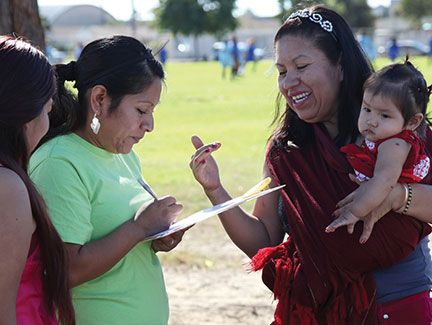

Virginia Garcia (in green) of the Mixteco/Indigena Community Organizing Project works with the Fielding School team to conduct health needs assessments of farmworkers and their families.
“They interact among themselves, but little with people outside their community,” says Dr. Annette Maxwell, a professor at the UCLA Fielding School of Public Health. "They take some of the hardest jobs and are often exploited. They have many needs, and have been mostly overlooked.”
Maxwell was part of a team of UCLA Kaiser Permanente Center for Health Equity and Center for Cancer Prevention and Control researchers who were conducting studies and training activities in Ventura County’s farmworker community when they were introduced to the Mixtecs. As they learned more about the population, Maxwell and colleagues found that many of the Mixtec women knew little about preventive services such as breast cancer screening, much less how to access them. For those who did, cultural norms dictating that no one should touch a woman’s body other than her husband posed a formidable barrier to seeking the exams.
Now the two Fielding School centers have forged a partnership with the Mixteco/Indigena Community Organizing Project (MICOP), an organization founded more than a decade ago as a means of addressing the pressing concerns of this most vulnerable of populations. Together, UCLA and MICOP have embarked on one of the first research projects in the Mixtec community to focus on breast health – and one of the largest systematic efforts to survey the needs of any indigenous community, undertaken by peers speaking the indigenous language.
Read the complete story in the Fielding School of Public Health magazine.
Read the complete story in the Fielding School of Public Health magazine.