She was a 93-year-old survivor of the Auschwitz-Birkenau concentration camp where the air was tainted with the smell of death. In 1945, she managed to escape from the Nazis into a forest when camp guards led her and other prisoners on a final death march as the Russian army approached.
He was a 19-year-old UCLA freshman who had signed up for a unique service-learning class to document the experiences of Holocaust survivors in order to preserve their memories for future generations.

Holocaust survivor Sophie Zeidman Hamburger met UCLA student Andrew Rosenstein when he enrolled in a course that trains students to preserve survivors' oral histories.
The class, taught by professor of Germanic languages and comparative literature Todd Presner, had a profound effect on students. Said Rosenstein, “Hearing survivors tell their stories is a very emotional process for both the survivors and the students. Just as survivors’ stories are complex, the emotions they evoke are also complex.”
Meeting Hamburger and other survivors was an experience that Rosenstein valued. “There are not many chances in your life to experience a first-person perspective of history,” he said. “There is a strong sense of community when you meet with survivors and hear their stories. The students became part of that shared history through learning from survivors.”
One year later, Rosenstein, an avid photographer, decided to use his camera to document these special encounters between Holocaust survivors and the UCLA students from Presner’s class as well as other student participants in the Bearing Witness Program offered by Hillel at UCLA. Presner’s class was developed in partnership with the UCLA Center for Jewish Studies, Hillel and the Jewish Family Service’s Café Europa, an organization offering support and community to survivors.
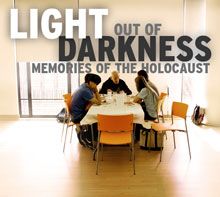
 Rosenstein’s photos, which portray Holocaust survivors as they share their moving life stories with students, are now on exhibit at the Los Angeles Museum of the Holocaust. “Light out of Darkness: Memories of the Holocaust,” featuring 36 photographs, is on view until the end of August.
“I thought it was very important to document this experience for future generations,” Rosenstein said. “You’re not simply reading from a history book. You’re actually with someone who lived through this, and, as time goes on, it becomes more important than ever to pass this part of history on to the next generation.”
Presner’s course, taught through lectures, readings and then biweekly interviews of survivors, offers UCLA students a chance to share survivors’ stories with many others whom they will never meet. Students write and then record 15-minute-long survivor histories that are incorporated into the museum’s iPod audio tours. Visitors can choose to hear a general history of the Holocaust as they move through the museum exhibits or listen to an individual survivor’s story, as told in the voices of the UCLA students. “In this way,” Presner said, “the UCLA students contributed to the creation and preservation of public memory of the Holocaust.”
 One moving photo shows a survivor listening to her own story, retold and recorded by a UCLA student who interviewed her.
As part of the course, students also posted the survivors’ stories on Hypercities, an interactive digital mapping platform developed by Presner to take users back in time to explore historical layers of places around the world. Survivors’ lives unfold in narratives and photos; on interactive maps, users can see the places key in their lives.
The relationships between the students and survivors grew as they met over a two-hour lunch held every other week during the quarter. “Many students developed close bonds with the survivors and met with them outside of class, over coffee, over dinner and even had Shabbat meals together,” said Presner, the Sady and Ludwig Kahn Director of the UCLA Center for Jewish Studies and chair of the Digital Humanities Program.
 In turn, said Presner, “the survivors valued the opportunity to transmit their stories to the students, who were eager listeners.”
Rosenstein’s photographs offer another way — one that "transcends the barriers of language and time," he said — for museum visitors to understand this painful period.
“From one perspective, these photos serve as documents of the ways students learned about the Holocaust from those who experienced it firsthand,” Rosenstein said. “But from another perspective, they can be seen quite literally as a single moment in time projected on a wall. It is up to us to give them meaning.”
_________________________________________________________________________________
_________________________________________________________________________________
To find out more about Sophie Hamburger’s life, go to the Holocaust Survivor Stories 2012 collection in Hypercities. You may need to download Google Earth to use Hypercities.