 It’s a dilemma that many college students would envy. UCLA students have a seemingly endless list of courses to choose from to satisfy requirements or electives — from global pop music and interracial dynamics to sex and from biology to a gendered society.
But among the tantalizing choices is one class that consistently draws UCLA undergraduates quarter after quarter: Introduction to Buddhism. It’s proven to be such a popular topic that the Department of Asian Languages and Cultures offered it during all three quarters of the 2012-13 academic year.
Naturally, some students who enroll are religion majors, and some are art history students with a specific interest in Buddhist art. There are also a number of students who are first-generation Asian Americans with a Buddhist background who wish to gain a greater understanding of the tradition and their respective cultures.
But among the many students who flock to this course are those who have been exposed to Buddhist images and ideas in American popular culture and seek deeper information about the religion. Many want to better understand themselves and their own religious orientation by studying another tradition.
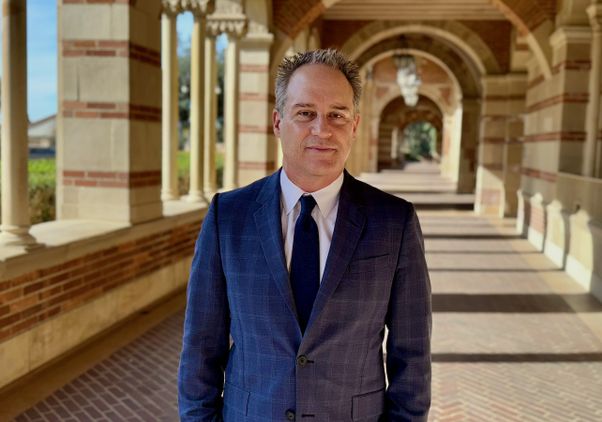
"Buddhism is a ‘sexy’ topic for young people," said Jason McCombs, a doctoral candidate in Buddhist studies who teaches the course through UCLA's Center for Buddhist Studies. "You won’t find the same level of enrollment, I don’t think, for introductory classes on western religions."
Freshman Sergio Garcia took the course last spring along with 95 other students who enrolled, enough to fill up four discussion sessions.
"What drew me to Buddhism, and, thus, this course, was its emphasis on the mind as the gatekeeper of experience," Garcia explained. "I am most interested in Buddhist philosophy, particularly of the Ch’an/Zen traditions and how these philosophies can be applied to holistically better one’s life."
Shannon Daly, who graduated in psychobiology last year, had to wait until her senior year to get into the class because of the high demand. "Although the saying by George Bernard Shaw — ‘There is only one religion, although there are hundreds of versions of it’ — resonates with me," she commented, "one unique and interesting thing about Buddhism is that anyone can eventually become a Buddha."
"I took the class mostly to combat the ignorance I had about non-western cultures," said first-year student Heather Rosen. "Because Buddhism is such a popular religion and culture, I thought it would be beneficial to have a basic understanding of another perspective on life that did not revolve around Jesus and Original Sin."  First-year student Neda Ashtari had a different perspective. She came to the course believing she was a Buddhist. But after studying its doctrines, mysticism and the rituals of the religion, she found she couldn’t "identify myself as a Buddhist. In the western world, we are so eager to call Buddhism a ‘philosophy’ or ‘a way of life’ that we neglect the true underpinnings of the religion — the rituals, the practices, the rules and regulations that comprise the religion … I have come to understand that I cannot read books written from a secular Western perspective and treat them as doctrinal documentation."
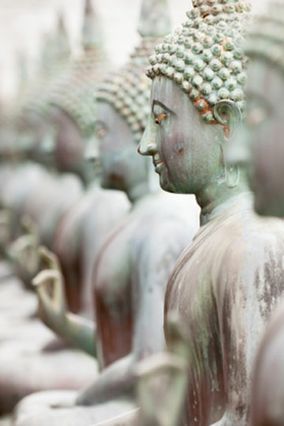
A Buddhist temple in Kyeongsang Bukdo, Korea. Photo by Christina L. Buswell.
It’s a tall order for faculty members to cover Buddhism’s development in India, its religious doctrines and meditative practices in only 10 weeks. But it’s a challenge that the instructors seem to enjoy.  "I’d worked as a teaching assistant for this course many times and then later taught my own version of the course. And I still find it intriguing and rewarding to teach," said instructor Karen Muldoon-Hules, who originally became interested in Buddhism when she lived in Japan for six years, traveled in Asia and visited ancient cave temples and monasteries in India. "I like the idea of having students visit local Buddhist groups and report back in the discussion section or on a discussion board about what they observed there."
Ph.D. candidate Jason McCombs and his infant daughter.
McCombs, who has a master’s degree in education from Harvard University and is writing his dissertation on gift-giving in Indian Mahayana Buddhism, also tries to visit a Thai temple in the San Fernando Valley with his students. "It allows students to get an insider’s presentation by a real Buddhist," he remarked. "In the past, students have raved about the experience."
Perhaps the most encouraging aspect about the enduring appeal of "Introduction to Buddhism" is the genuine intellectual curiosity of UCLA students, who recognize the need to learn about beliefs and cultures other than their own. In the process, students often gain a better comprehension of their own religious backgrounds.