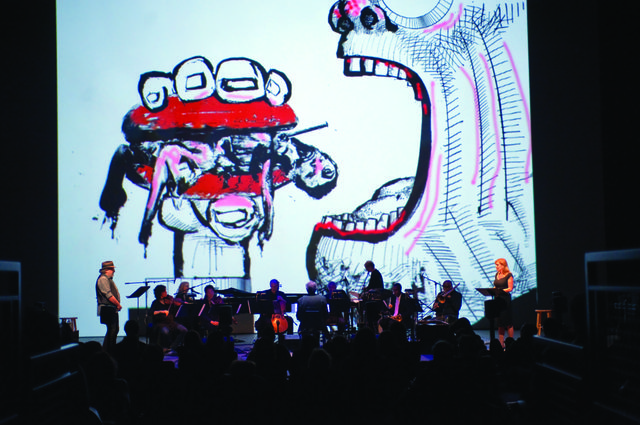

A scene from CAP UCLA’s “Allen Ginsberg’s ‘Kaddish’: A Hal Willner Project.”
It was 65 years ago that Kerouac coined the phrase "Beat Generation" during a conversation with fellow writer John C. Holmes. The word "beat," colloquially meaning "tired" or "down and out," gained historical significance when Kerouac and Ginsberg began to infuse the word with a "beatific," mystical connotation. The central elements of Beat culture came to include drug experimentation, sexual freedom and an interest in Eastern religion — not to mention rejection of conventional standards and materialism.
On April 17 at 8 p.m. in Royce Hall, CAP UCLA will salute one of the Beat Generation’s most iconic writers with the West Coast debut of "Allen Ginsberg’s ‘Kaddish’: A Hal Willner Project." The performance is music producer Hal Willner’s live staging of Ginsberg’s 1961 poem "Kaddish for Naomi Ginsberg (1894–1956)," a lament on the loss of his mother and a reflection on his own estrangement from Judaism.
"Kaddish," directed by Chloe Webb, features Willner and Webb performing the poem accompanied by a live score written and conducted by Grammy Award-winning jazz guitarist Bill Frisell. In the background are projected paintings by "Gonzo" artist Ralph Steadman, incorporated into a film by Webb.

American artist Vito Paulekas, a notable influence on the bohemian scene in Southern California, is interviewed in 1960 on the local human interest TV series "On the Go" (broadcast preserved by UCLA Film & Television Archive).
In a lecture called "Becoming Beat and Post-Beat in L.A.: Strange Facts and Fictions About the Los Angeles Poetry Renaissance," poet and professor William Mohr, who teaches literature and creative writing at CSU Long Beach, will talk about how the Beat movement spawned a startling and unexpected renaissance of Southern California poets in the 1970s and 1980s that continues to this day. The lecture takes place on Thursday, April 11, at 4 p.m. in the UCLA Charles E. Young Research Library’s Main Conference Room.
Two free exhibits will run from April 11–June 14: The first, "I’m a Stranger Here Myself: Poets in Post-WWII L.A.," will be housed in the Young Research Library’s Department of Special Collections and will include historical documents about the Beat writers and their place within the complex, contentious literary landscape of Los Angeles during the McCarthy era. The second exhibit, "Beat 101," will be installed in the Powell Library Rotunda and will feature books, journals, photos and audio clips that illustrate the impact of Beat culture on Los Angeles.
The UCLA Film and Television Archive’s Dan Einstein and Mark Quigley will present "Like, Dig: Beats in the UCLA Film and Television Archive," a curated selection of vintage local and network television footage featuring beatniks, beat poets and their hangouts in L.A., including the famous Ash Grove. The free event will take place in the Charles E. Young Research Library’s Presentation Room on Monday, April 15, at 1 p.m.

From the UCLA Library's Special Collections: Pages from one of Beat poet Stuart Perkoff's journals from 1960. Perkoff's notebooks contain numerous drawings and collages reflecting a range of emotional states — from hilarity to despair — as well as fragments and first drafts of his published poems.