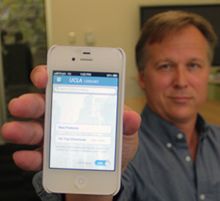

Students in Simul8 design and maintain apps for UCLA Library. The team functions like a start-up and provides students the opportunity to apply their computer coding knowledge in real-world settings.
The iPhone had launched in June of that year, and, over the next year as he watched more and more students, staff and faculty walk across campus while playing with their phones, Rundblad realized that the library would need to find a way to get its rich digital resources into the hands of its users.
To do this, Rundblad needed programmers. But he didn’t want to just put out a contract and hire a private company.
"I really wanted to bring students in to do the work. There are students here with the skills," said Rundblad, who came to UCLA after running a small online video start-up in Denver. "Because students are also a central demographic for the library, we have a development team that has great skills, and also can serve as a voice of the user."
Although Rundblad had taken himself out of the start-up world, the start-up ethos was still there inside him. So in 2008 he formed Simul8, a team of student programmers that would develop mobile and Web apps for the library. In nearly five years since its launch, students have built various experimental prototypes, as well as launched four apps that work on iPhones, Android phones and tablets.
There’s the general library app that lets users search the catalog (and see where in the library a book or article is physically located), check laptop availability and view course reserves. Another creation, Article Search, allows users to find academic papers and articles, while Stashd, the latest app, allows users to save online articles to their UCLA accounts for future reading on any device.
Collectively, the iOS and Android apps have been downloaded more than 7,000 times by campus users. "That’s a number we can build on," Rundblad noted.
Like many start-ups, the first challenges Rundblad had to overcome were finding money and recruiting talent. To deal with the first, Rundblad said he was fortunate to have support from the Library. "Recently retired University Librarian Gary Strong saw the value and secured funding through a grant from the Arcadia Fund," said Rundblad, who is now the user experience and social technology strategist for the library.
To find programmers, Rundblad sent emails to faculty, and the library posted job openings for programmers on its website. By mid-2009 he had a team of five, which ironically had zero computer science majors. Students don’t have to be computer science majors, but they do need to know some coding and must be willing to learn, Rundblad said.
Immediately, Rundblad’s experience of running a start-up shaped Simul8’s culture — work whatever hours you want as long as you attend one weekly two-hour group meeting, defer to others’ expertise and forget about hierarchy.
"Kevin and John [John Wang, former head of library web services who co-founded Simul8 with Rundblad] always made us feel free to experiment and invent," said Adrien Husson, who, as a student with Simul8, built on a predecessor’s work to create a way to search 50 separate electronic document collections at once. "Students had to manually search each of those collections using a variety of interfaces, which was frustrating and exhausting."
Husson, who studied film at UCLA and the University of Melbourne, said that his work on the library apps was so rewarding that he’s now studying theoretical computer science at the École Normale Supérieure de Cachan in France.
Recent computer science graduate Christina Fries worked on the Android app for the library. Like other Simul8 alumni, Fries said that she never expected to work at an on-campus start-up.

Simul8 co-founder Kevin Rundblad shows off the group's latest UCLA Library app for the iPhone. The new tool allows students to see course reserves for classes.
Once Simul8 established itself, recruiting became a lot easier because the students found new recruits, Rundblad said. "Those students know who’s good and who’s not."
Case in point: Tarry Chen, who heard about Simul8 from Fries.
"I thought it was pretty forward-thinking of the library to hire student employees to help them develop web and mobile applications," said Chen, who has since graduated and now works for Amazon as a software development engineer. "It just makes so much sense. They are also more vested in the final product if the application is targeted at fellow students like themselves."
Thanks to Chen, users now know where a book is located in the library when they search for it on their phone. "Kevin mentioned how this feature would make it convenient for students to find books," said Chen, especially since call numbers sometimes jump from place to place. With guidance from a digital map of Powell Library, he walked down rows and rows of shelves, marking on the map where the call numbers were. With an assist from fellow student Rajiv Tirumalareddy, he turned his map into code and now library users can see where the book they're looking for is.
What’s next? There are other apps in the earlier stages of development. But coming up with new apps is not Rundblad’s entire endgame.
"It’s not just about building apps, " said Rundblad, who added that in the future he’d like to create similar types of groups for non-computer science majors. "The great thing is that the Simul8 group provides a real-world situation for students to gain experience and release products. As result, they will have much more to show future employers than just course work."
All of the students who have participated in Simul8 and graduated got jobs right away, he said.
Tirumalareddy, who graduated in 2012 with a degree in aerospace engineering, actually secured his job before graduating thanks to Simul8.
"In many ways what you do at Simul8 surpasses internships. You get real responsibility," said Tirumalareddy, who, at 22, is chief technology officer and chief programmer for Storystrings, which aims to bring beautiful design to blog publishing. "You can affect what the whole group does by voicing your opinion. You're always asked what you want to work on, not told what to do. This doesn't even sound too much like a job to me. If it weren't for Simul8, I wouldn’t be where I am today."
Students interested in joining should go to the Simul8 website. You don’t have to be a computer science major, but Rundblad said that you must have the drive to independently learn the newest technologies and user interactions.