 Although tax season doesn’t usually summon warm feelings for most of us, this year it might help to know that some students at UCLA use tax season to do some good in the world.
UCLA is home to one of the most prestigious chapters of the the national Volunteer Income Tax Association. VITA students at UCLA donate their time to help low-income individuals and local community members file their taxes. They even help people on campus — each year, hundreds of grad students, staff and faculty show up at their sessions for free filing and advice.
Hyun-Gyum Shin, a third-year math and economics major and the group’s co-president, found out about VITA from a friend.
“I saw the potential that it could have," Shin said, "not just for my resume but also to provide a service for UCLA and the community as a whole.”
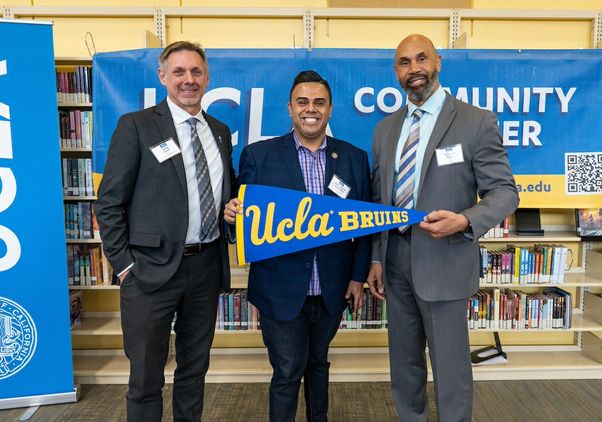
The roughly 200 students, trained by tax professionals in a 20-hour tax course (plus ethics training) and vetted by the IRS, set up shop on campus and at public libraries. Last year they filed close to 1,000 returns, helping taxpayers collect over $420,000 in refunds.
The group uses campus funding to advertise their services inside city buses and Bruin buses. They also post flyers and hope for publicity via interdepartmental emails, while also getting referrals from the IRS.
Since many people hardly trust themselves to do their own taxes, how do VITA volunteers handle taxpayers skeptical about handing their documents to a teenager?
“It’s not so much about showing them how much knowledge you have,” said Shin. “We’re undergraduate students, not full-time professionals with CPAs, and the clients do understand that. What I’ve learned is to just be honest, show them that we are confident in handling these cases, and in the checks and balances we have instituted."
The roughly 200 students, trained by tax professionals in a 20-hour tax course (plus ethics training) and vetted by the IRS, set up shop on campus and at public libraries. Last year they filed close to 1,000 returns, helping taxpayers collect over $420,000 in refunds.
The group uses campus funding to advertise their services inside city buses and Bruin buses. They also post flyers and hope for publicity via interdepartmental emails, while also getting referrals from the IRS.
Since many people hardly trust themselves to do their own taxes, how do VITA volunteers handle taxpayers skeptical about handing their documents to a teenager?
“It’s not so much about showing them how much knowledge you have,” said Shin. “We’re undergraduate students, not full-time professionals with CPAs, and the clients do understand that. What I’ve learned is to just be honest, show them that we are confident in handling these cases, and in the checks and balances we have instituted."
"We tell them the entire process," said Shin, who explained that the completed tax forms must be accepted by proprietary IRS software, go through two separate reviews by the top VITA officers and then a quality-control review by the IRS.
“If we do make a mistake, the IRS will reject it, and we’ll be able to make amends without penalizing the client,” said Shin. “You’re not penalized unless you provide us with false documentation. So clients feel comforted by the fact that even if we make a mistake, they’re not the ones who have to fix the problem. And historically, we have such a low rejection rate, clients are comfortable trusting us.”
 Don’t think the IRS reserves their scrutiny just for taxpayers; VITA members also get random audits.
“They come disguised as regular taxpayers with a scenario, usually a situation that most VITA volunteers get wrong," said Shin. "They have us file their taxes, then they [evaluate us].”
And how does the group measure up?
Don’t think the IRS reserves their scrutiny just for taxpayers; VITA members also get random audits.“They come disguised as regular taxpayers with a scenario, usually a situation that most VITA volunteers get wrong," said Shin. "They have us file their taxes, then they [evaluate us].”
And how does the group measure up?
“We got audited last week," Shin said. "The lady was very pleased! She was talking about how great we were… our IRS coordinator told us we have one of the lowest rejection rates in the greater Los Angeles area. We’re one of the biggest VITAs in this area, and we’re also one of the best.”
Each year, VITA receives upwards of 400 applications for fewer than 200 spots. Club officers have taken to filtering out applicants by their GPA, followed by their commitment to service.
Each year, VITA receives upwards of 400 applications for fewer than 200 spots. Club officers have taken to filtering out applicants by their GPA, followed by their commitment to service.
You might wonder what kind of student would volunteer to work on taxes in their spare time when other clubs promise more … recreational activities. But VITA members do have fun. They organize social activities as a club like any other club, and they also genuinely enjoy the work.
“Volunteers have a good time,” said Shin. “Once they start, they say, ‘It feels so good to be helping these people out, I can’t believe I’m filing these people’s taxes!’ And our clients are so happy and appreciative there’s a service like this.”
And the perks of high performance in VITA are huge. The club is in constant contact with the “Big Four” accounting firms of PricewaterhouseCoopers, Deloitte, KPMG and Ernst & Young, which provide everything from training sessions to secure laptops. The firms routinely look to VITA's UCLA chapter to recruit job candidates.
“Volunteers have a good time,” said Shin. “Once they start, they say, ‘It feels so good to be helping these people out, I can’t believe I’m filing these people’s taxes!’ And our clients are so happy and appreciative there’s a service like this.”
And the perks of high performance in VITA are huge. The club is in constant contact with the “Big Four” accounting firms of PricewaterhouseCoopers, Deloitte, KPMG and Ernst & Young, which provide everything from training sessions to secure laptops. The firms routinely look to VITA's UCLA chapter to recruit job candidates.
“Over the summer, Disney emailed us asking if we could send out an [announcement of an] open position, just because they know the quality of our volunteers," said Shin. "Ernst & Young do special presentations just for our volunteers. Other firms ask if they can have private recruiting sessions.”
Shin, who has attended several by-invitation-only mixers, eventually accepted an internship offer from PricewaterhouseCoopers.
“These are some of the best and the brightest UCLA students,” said Shin. “We’re a service organization, but because of the nature of the work we do, we have a very strong career pool. A lot of upperclassmen want to join, seeing what a great networking opportunity this is. For underclassmen, it’s a great way to start their career at UCLA and build up a resume. And since a lot of our board members get full-time offers from firms, they don’t view us just as a student organization, because our members are going to be working for them.”
After their first paid internships -- bringing in their first real income -- UCLA VITA volunteers often get to file their own taxes for the first time. “They are really excited,” said Shin. “They know they’re on their way to becoming a fully independent adult, not just being a student. Former officers actually had the volunteers file for them. They say it's ‘to have them practice,’ but I think they also wanted to feel what it’s like to finally graduate and go through all of this [as a client].”
To bring more focus to their tradition of service, UCLA VITA partners with other UCLA volunteer organizations, joining them on trips into the community and conducting financial literacy forums for underprivileged families. They also advise UCLA graduate and international students about paying for college, filling out FAFSA (financial aid) forms, managing their money and tax basics.
 As the April 15th tax-filing deadline draws near, life gets hectic for VITA members. Some volunteer sites find officers under constant pressure for hours, reviewing other volunteers’ returns, going over forms with clients, troubleshooting from table to table.
“I can’t really describe how chaotic it gets,” said Shin. "Clients at the off-campus sites sometimes must wait hours to be seen.
"Sometimes we run into the unfortunate case where these clients are sitting there for three hours, and we have to turn people away," said Shin. If a case is too complicated, "we just tell the clients, 'sorry, we're not qualified to do your return,' and they're referred to a professional."
"Sometimes we run into the unfortunate case where these clients are sitting there for three hours, and we have to turn people away," said Shin. If a case is too complicated, "we just tell the clients, 'sorry, we're not qualified to do your return,' and they're referred to a professional."
Those cases are most often clients who must itemize their returns. Itemizing, Shin said, suggests you're earning more than taxpayers who take a standard deduction. "Because we are geared towards low-income families, I would prefer to give opportunity to those clients who are in need. It's hard for me to encourage a volunteer to waste an hour or two trying to do a complicated return [for someone who can afford to pay a professional]."
Turning someone away isn't always easy.
“Last Saturday," Shin recalled, "two girls came (to a library site) with their father, who works Monday through Friday, 14 hours a day, so he has absolutely no time to file taxes. They were hoping he could get his returns done so they could file their FAFSA." But they were already 10 minutes past closing time for the library. "It’s so difficult to say no to a client, especially knowing their circumstances.”
Shin focuses on the positive -- the many satisfied clients that come back year after year. Few groups around the country provide this kind of free service to the public, and high demand for the group’s services is an encouraging sign.
“It means we’re well-publicized and that we’re trusted,” said Shin.
Shin focuses on the positive -- the many satisfied clients that come back year after year. Few groups around the country provide this kind of free service to the public, and high demand for the group’s services is an encouraging sign.
“It means we’re well-publicized and that we’re trusted,” said Shin.