While on a yearlong sabbatical at the École Polytechnique Fédérale de Lausanne in Switzerland, Luisa Iruela-Arispe received some happy news: She had been named the winner of the 2013 Gold Shield Faculty Prize, a $30,000 award sponsored by Gold Shield, Alumnae of UCLA.
A professor of molecular, cell and developmental biology, Iruela-Arispe is the 18th winner of the Gold Shield prize, awarded annually to a full professor in mid-academic career in recognition of extraordinary accomplishment in undergraduate teaching, research and creative activity, and service to UCLA.
A professor of molecular, cell and developmental biology, Iruela-Arispe is the 18th winner of the Gold Shield prize, awarded annually to a full professor in mid-academic career in recognition of extraordinary accomplishment in undergraduate teaching, research and creative activity, and service to UCLA.

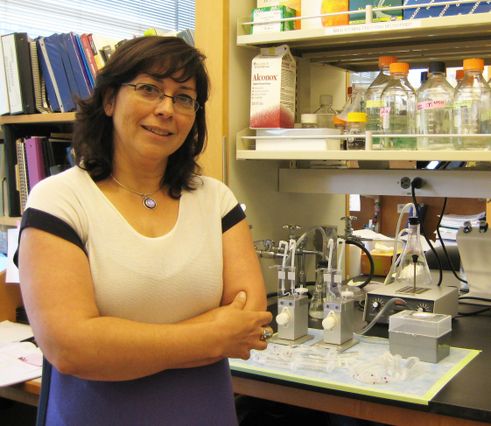
Praised by her colleagues and students alike, Luisa Iruela-Arispe always knew biology would be in her future. She studies the molecular and cellular mechanisms that drive the formation of blood vessels.
Iruela-Arispe serves as interim director of the Molecular Biology Institute, chair of the Interdisciplinary Molecular Biology Graduate Program and director of the Cancer Cell Biology Program Area in the Jonsson Comprehensive Cancer Center. News of the award came as a happy surprise to her, she said.
“There are fantastic faculty here, and I’m just so impressed with the commitment, devotion and shared love that some of these individuals have for education,” she said. “I feel incredibly honored to have been selected, because I know this was probably a difficult competition. I’m just very happy and beyond myself.”
Utpal Banerjee, professor of biological chemistry and chair of the Molecular, Cell and Developmental Biology Department, said he nominated Iruela-Arispe for the award because she exemplifies what one seeks in an academic leader.
“She is a professor in the true sense of the word, not only delivering high-quality education and research, but striving to build the UCLA scientific community and constantly improving its research and educational environment,” Banerjee said. “I am ecstatic that she was chosen. We rejoice in her reflected glory.”
Iruela-Arispe took three students from her lab — two graduate students and a postdoctoral fellow — to Lausanne, where they collaborated with colleagues on research focusing on blood vessels and cancer. In her own research on vascular biology, Iruela-Arispe studies molecular and cellular mechanisms that drive the formation of blood vessels.
“Why do blood vessels go where they go? We study their stability and patency; that is, their functional well-being. Making sure they’re not collapsing, they’re not closing,” she explained. “For example, atherosclerosis is a disease that leads to the closure of blood vessels, and that results in heart attacks. So we’re interested in the mechanisms that ensure that the vessels stay open.”
Austin McDonald, a dual M.D./Ph.D. student in Iruela-Arispe’s lab, was one of the three young researchers who traveled to Lausanne. “Professor Iruela-Arispe is, simply, an outstanding mentor for a young scientist,” he said. “She pushes her students to their limits, but always with warmth, laughter and a grin. She would hate to hear this, but she’s like a mother to her students. I’m not at all surprised she won.”
Born in Madrid, Spain, Iruela-Arispe always knew that biology would be in her future, and she never veered from her career plans. Her family moved often: When Iruela-Arispe was 5, her father sought to escape General Francisco Franco’s regime and relocated the family to Argentina. Ten years later, when Argentina’s economy began to falter, they moved to Brazil.
Despite the fact that she had to change schools often, Iruela-Arispe excelled in primary school and skipped a few grades; as a result, she ended up going to high school at age 13. “A 13-year-old with 15- [and] 16-year-olds, that doesn’t go very well,” she said, laughing. She received her master’s degree in histology (cellular anatomy) and embryology from the Federal University of Rio de Janeiro and, at age 20, earned a position as a tenured professor at the Rio de Janeiro State University.
“There were many issues,” Iruela-Arispe recalled wryly. “I was a woman. I was young. Not too bad-looking. That was a problem. So I was always trying to look older and very conservative. In retrospect, it was a nice problem to have!”
After two years of teaching, the young professor started work on her Ph.D. at the University of São Paulo, which she earned in 1989. She completed postdoctoral training at the University of Washington in Seattle, where she met her future husband, Timothy Lane, now a UCLA associate professor of obstetrics/gynecology and biological chemistry. From 1994–1998, Iruela-Arispe served as assistant professor in the Department of Pathology at Harvard Medical School. She joined the faculty at UCLA in 1998.
Since returning from Switzerland, Iruela-Arispe has been busily moving into her new home in Westwood with Lane and their two children, Christina and Alex. The upcoming academic year is not far from her mind, however: She already has plans to spend the $30,000 Gold Shield prize on new computers for her lab.
“This is a very unique prize because of its focus on mid-career achievements. Usually focus tends to be on the young faculty members who are just starting out, which is really important, or on the people who are retiring, as an acknowledgement of long-term contributions,” Iruela-Arispe said. “But when you’re in the guts of it, it feels like nobody is paying attention, and so this award is very special. It sends the message: ‘We are paying attention. We’re watching, and we would like to reward the people who are doing a good job.’ ”
“There are fantastic faculty here, and I’m just so impressed with the commitment, devotion and shared love that some of these individuals have for education,” she said. “I feel incredibly honored to have been selected, because I know this was probably a difficult competition. I’m just very happy and beyond myself.”
Utpal Banerjee, professor of biological chemistry and chair of the Molecular, Cell and Developmental Biology Department, said he nominated Iruela-Arispe for the award because she exemplifies what one seeks in an academic leader.
“She is a professor in the true sense of the word, not only delivering high-quality education and research, but striving to build the UCLA scientific community and constantly improving its research and educational environment,” Banerjee said. “I am ecstatic that she was chosen. We rejoice in her reflected glory.”
Iruela-Arispe took three students from her lab — two graduate students and a postdoctoral fellow — to Lausanne, where they collaborated with colleagues on research focusing on blood vessels and cancer. In her own research on vascular biology, Iruela-Arispe studies molecular and cellular mechanisms that drive the formation of blood vessels.
“Why do blood vessels go where they go? We study their stability and patency; that is, their functional well-being. Making sure they’re not collapsing, they’re not closing,” she explained. “For example, atherosclerosis is a disease that leads to the closure of blood vessels, and that results in heart attacks. So we’re interested in the mechanisms that ensure that the vessels stay open.”
Austin McDonald, a dual M.D./Ph.D. student in Iruela-Arispe’s lab, was one of the three young researchers who traveled to Lausanne. “Professor Iruela-Arispe is, simply, an outstanding mentor for a young scientist,” he said. “She pushes her students to their limits, but always with warmth, laughter and a grin. She would hate to hear this, but she’s like a mother to her students. I’m not at all surprised she won.”
Born in Madrid, Spain, Iruela-Arispe always knew that biology would be in her future, and she never veered from her career plans. Her family moved often: When Iruela-Arispe was 5, her father sought to escape General Francisco Franco’s regime and relocated the family to Argentina. Ten years later, when Argentina’s economy began to falter, they moved to Brazil.
Despite the fact that she had to change schools often, Iruela-Arispe excelled in primary school and skipped a few grades; as a result, she ended up going to high school at age 13. “A 13-year-old with 15- [and] 16-year-olds, that doesn’t go very well,” she said, laughing. She received her master’s degree in histology (cellular anatomy) and embryology from the Federal University of Rio de Janeiro and, at age 20, earned a position as a tenured professor at the Rio de Janeiro State University.
“There were many issues,” Iruela-Arispe recalled wryly. “I was a woman. I was young. Not too bad-looking. That was a problem. So I was always trying to look older and very conservative. In retrospect, it was a nice problem to have!”
After two years of teaching, the young professor started work on her Ph.D. at the University of São Paulo, which she earned in 1989. She completed postdoctoral training at the University of Washington in Seattle, where she met her future husband, Timothy Lane, now a UCLA associate professor of obstetrics/gynecology and biological chemistry. From 1994–1998, Iruela-Arispe served as assistant professor in the Department of Pathology at Harvard Medical School. She joined the faculty at UCLA in 1998.
Since returning from Switzerland, Iruela-Arispe has been busily moving into her new home in Westwood with Lane and their two children, Christina and Alex. The upcoming academic year is not far from her mind, however: She already has plans to spend the $30,000 Gold Shield prize on new computers for her lab.
“This is a very unique prize because of its focus on mid-career achievements. Usually focus tends to be on the young faculty members who are just starting out, which is really important, or on the people who are retiring, as an acknowledgement of long-term contributions,” Iruela-Arispe said. “But when you’re in the guts of it, it feels like nobody is paying attention, and so this award is very special. It sends the message: ‘We are paying attention. We’re watching, and we would like to reward the people who are doing a good job.’ ”