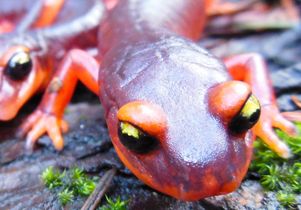
Researchers from the UCLA Institute of the Environment and Sustainability call for a federal ban on salamander imports to prevent a deadly pathogen from coming here.
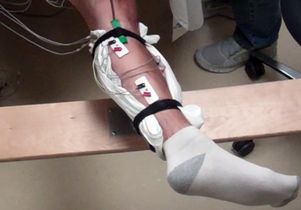
Five men who have been completely paralyzed for years moved their legs in a rhythmic motion, thanks to a noninvasive method of stimulating the spinal cord, UCLA scientists report.
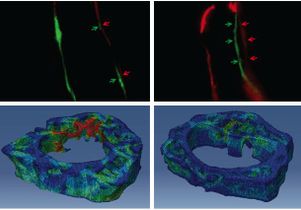
Results could one day have an impact on the development of a treatment for osteoporosis as well as potentially help those with traumatic bone injuries.
Braving floods, fires and vampire mosquitoes, UCLA professor Susan Perry has spent 25 years chasing capuchin monkeys through the forests of Costa Rica. Her data have transformed what we know about these fascinating primates.
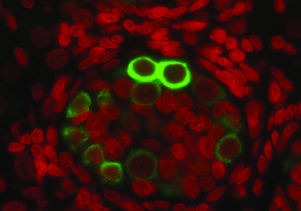
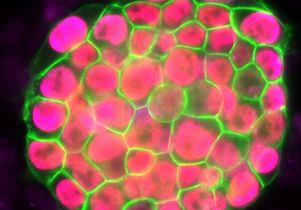
Research by scientists at the Broad Stem Cell Research Center shows that the cells carrying parents’ genes to a child are unprotected during part of the prenatal stage of development.
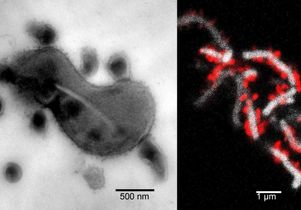
California NanoSystems Institute researchers have imaged the atomic structures of three specific biological nanomachines, findings they hope advance work on antibiotics targeted toward specific pathogens.
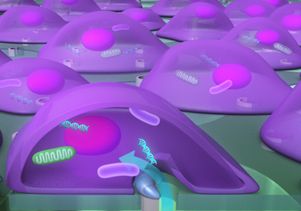
UCLA engineers and doctors developed a tool that can deliver nanoparticles, enzymes, antibodies and bacteria into cells thousands of times faster than current technology.
Life scientists have created an accurate new method to identify markers for many diseases — a significant step toward a new era of personalized medicine, tailored to each person’s DNA and RNA.
Screening travelers for fever on arrival has been criticized as ineffective, but the scientists found it can catch cases that screeners miss at departure.
Darwin’s writings focused much more on species that had changed over time than on those that hadn’t. So how do scientists explain a species living for so long without evolving?
A team of life scientists has found part of the answer: The amount and intensity of striping in different zebra populations can be best predicted by temperature.
UCLA researchers found that although Prozac and Lexapro were thought to work the same way, the medications did not produce the same long-term changes in anxiety behavior.
The scientists resolved a dispute over whether a small population of black-headed squirrel monkeys, which are found only in an isolated part of Brazil, is a sub-species of another species or its own species.
A new research institute at UCLA may eventually provide doctors with tools to more accurately tailor therapies to patients, which would improve care and minimize side effects.
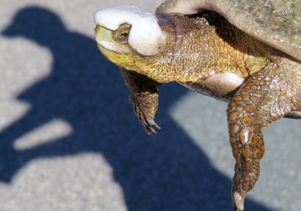
Biologists with the UCLA La Kretz Center for California Conservation Science recently went on a rescue mission to save endangered turtles that have become dehydrated, emaciated and stressed-out by the extended drought.
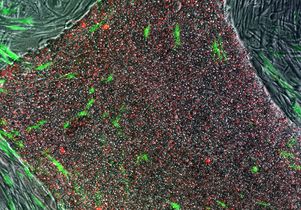
Scientists from UCLA, Harvard, Mass General and Stanford present strong evidence that a chemical modification on RNA plays a key role in determining embryonic stem cells’ ability to adopt different cellular identities.