The technique, called a "non-malleable commitment," is the electronic equivalent of a lockbox and requires only two rounds of one-way communication from the sender to the recipient.
Teams of UCLA students, staff and faculty who have created clever, first-of-their-kind software and applications that use the latest technologies to help solve problems unveiled the result of thousands of hours of hard work Thursday at a campus conference.
The research could improve scientists’ ability to understand health care, economics and the environment, and to glean much more pertinent insight from data.
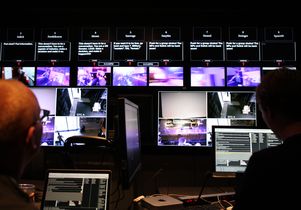
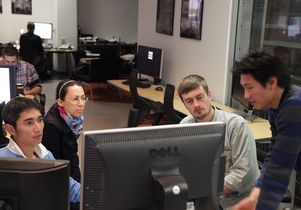
The project asked UCLA students to use their skills to build an app that uses voice and speech recognition to analyze and improve the dynamics of group interactions.
The sites perform sophisticated, real-time reasoning to ensure that a specific vehicle could be manufactured with the consumer’s preferred combination of options and features.
More than 1,000 high school and college students from across the United States descended last weekend on UCLA’s Pauley Pavilion to plug into LA Hacks, a collaborative computer programming event organized by two UCLA student groups and sponsored by LA 2024.
UCLA students can now compete for a chance to assist UCLA Chancellor Gene Block with developing his idea into a mobile application that will use voice and speech recognition to analyze and improve the dynamics of group interactions.
Thyrosim can be used by clinicians, researchers and educators to gauge the impacts of thyroid treatments and to develop more effective remedies for thyroid problems.
Denisovans, ancient hominids who lived alongside humans and Neanderthals, were first described in 2010 through DNA extracted from remains in a Siberian cave in 2008.
UCLA professor Linda Sax is leading a multi-institutional study that could help determine ways to increase the low numbers of women, in particular women of color, in college computer science programs.
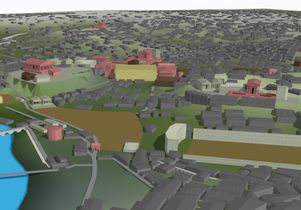
Intrigued by the question of whether Augustus Caesar transformed Rome from a city of bricks into a city of marble, as legend has it, UCLA professor Diane Favro decided to use advanced modeling software to reconstruct Rome at the time of his reign.
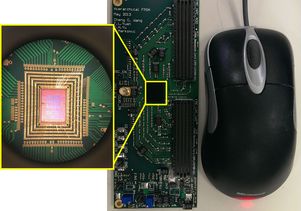
Two engineering graduates are the first employees in a new Mountain View startup that will use their innovation in the design of an important semiconductor chip.
UCLA will host universities and technology companies who are working to promote the development and adoption of Named Data Networking, an emerging Internet architecture.
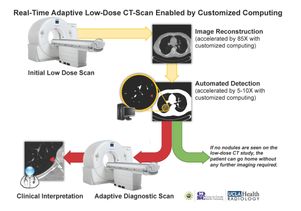
The NSF and semiconductor giant Intel Corp. have partnered to support UCLA research that could reduce radiation from CT scans and lead to the development of new cancer treatments.
The Roseline project, headquartered at UCLA, will work to improve the accuracy and efficiency with which computers maintain their knowledge of physical time and synchronize it with a variety of networked devices.
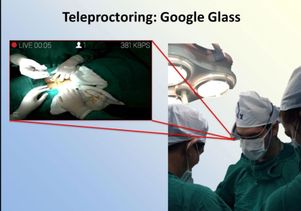
UCLA surgeon Dr. David Chen and surgical resident Dr. Justin Wagner have made it their mission to teach hernia surgery around the world and are using Google Glass as a training tool to watch procedures and comment in real time.
A hidden message left by a UCLA architect in 2011 was recently uncovered in Boelter Hall, where sharp-eyed passersby can spot a coded note in the pattern of floor tiles.
Arguably the most collaborative space on campus, where disciplines like computer science, urban planning, Near Eastern languages and cultures and interactive mapping collide into creative scholarship.