UCLA professor Henry Kelly examines historical canonical legal procedures to correct the popular myths around the Italian astronomer’s belief in a sun-centered solar system.
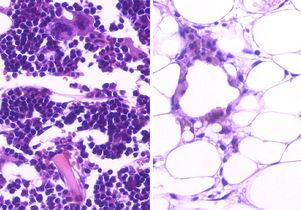
The team found a way to correct the instability by resetting the stem cells from a later stage of development to an earlier stage. These results could have great impact on the creation of healthy tissues to cure disease.
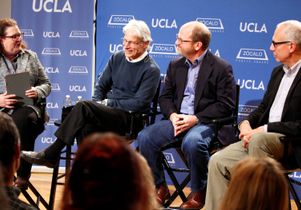
Two UCLA faculty members — molecular biologist Robert Goldberg and international law and policy scholar Edward Parson — defended the use of genetically modified organisms in food production at a Zócalo/UCLA discussion held in downtown Los Angeles.
The findings could help improve upon standard behavioral therapy, in which people are exposed to the objects they’re afraid of — which can be frightening enough that some cannot complete treatment.
Researchers from the schools of dentistry, medicine and engineering developed a digital health platform capable of optimizing efficacy and safety during chemotherapy.
An multidisciplinary team designed an algorithm that could discern structured narratives within the flow of posts on the internet reflecting how humans communicate.
Mitochondrial DNA discoveries by a team of UCLA and Caltech scientists may help to prevent or delay the onset of age-related diseases such as Parkinson's and Alzheimer's.
The development of DZ-2384 by UCLA chemists led to an international research collaboration which found that the molecule appears to help fight several types of cancer.
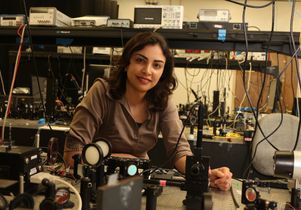
The technique, called a "non-malleable commitment," is the electronic equivalent of a lockbox and requires only two rounds of one-way communication from the sender to the recipient.
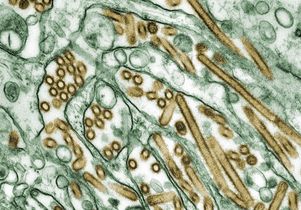
UCLA researchers note that the next decade shows great promise for things like improving food safety, fighting infections, storing energy and supplying clean energy.
A study by UCLA researchers found that a noninvasive method can help to determine whether an individual will enter remission after just one week of medical treatment.