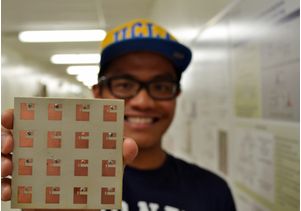
Terahertz waves can be used to analyze plastics, clothing, semiconductors and works of art without damaging them and to investigate the formation of stars, among other applications.
The new cell construction extends the cell’s effective life in air by more than 10 times, with only a marginal loss of efficiency converting sunlight to electricity.
The method may help lead to much smaller but more powerful linear electron-positron colliders — machines that could be used to understand the properties of nature’s fundamental building blocks.
UCLA Engineering has joined with a Korean youth organization to establish the program, which will focus on addressing malaria and other global health challenges.
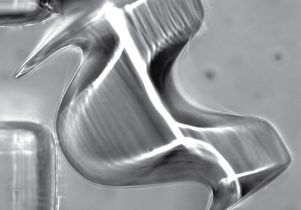
The new ceramics hold promise for use in miniature mechanical components and flexible-yet-strong foils for use in solar sails, which are used to propel spacecraft, among many other applications.
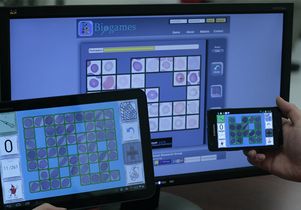
A new event created by the Ozcan Research Group of UCLA’s Henry Samueli School of Engineering and Applied Science showcased an impressive array of biomedical engineering technology research.
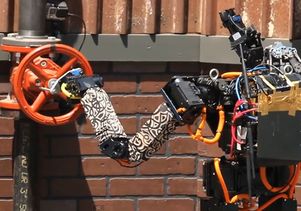
UCLA robotics expert Dennis Hong and a team of students competed with THOR, their humanoid robot, in a contest to build a robot that can go places too dangerous for humans.
Jean Paul Santos will compete May 4 against other campus winners of Grad Slam. His speech, “How to Talk to Mars,” helped him win UCLA's inaugural competition.
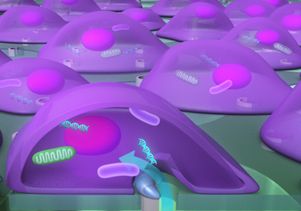
UCLA engineers and doctors developed a tool that can deliver nanoparticles, enzymes, antibodies and bacteria into cells thousands of times faster than current technology.
New compact, reliable energy storage devices outperform batteries by holding larger amounts of energy, recharging more quickly and lasting for longer recharge cycles.
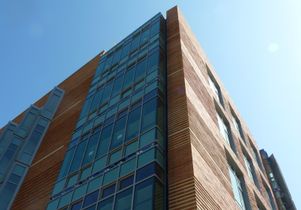
UCLA leaders and prominent alumni gathered March 19 to celebrate the new jewel of the Henry Samueli School of Engineering and Applied Science, Engineering VI.